
At the 2025 Ovation Users’ Group Conference, Emerson’s Ole Binderup presented Wind Turbine Optimization. He addressed wind turbine challenges and how the Ovation Green Wind Turbine Operation and Control Solutions help to overcome these challenges. Key challenges include:
- Wind Turbine Control – Old turbine control not performing due to non-optimal parameter settings or old control strategy. No or limited access to wind turbine parameters and operational data
- Wind Site Assessment – The wind site assessment is one of the most critical steps in the development of a wind park. Wind conditions can vary a lot within the same site, resulting in the turbine operating in more or less severe conditions
- Blades – Contaminant accumulation and erosion can occur at the leading edge, with a negative impact on power production
- Static Yaw Misalignment – Static yaw misalignment is caused by the bad mounting of the wind vane
- Pitch Misalignment – Caused by wrong blade installation or bad 0° reference marking
Control retrofits enable the design of customized logic based on feedback from the remote operation center and field engineers, optimizing maintenance time and turbine availability. For example, by adding an input for the bearing greasing system to the retrofit solution, it can act accordingly, and give an alarm when the grease level is low or faulty, to plan a service visit.
Other sensors include wind sensors, smoke/fire alarms, vibration sensors, pressure sensors, supervising sensors, and many more.
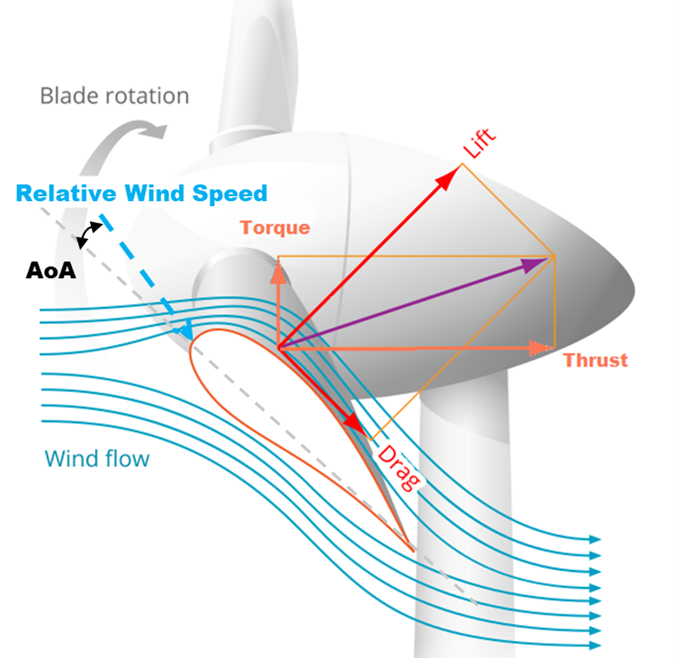 Control strategies for wind turbines include safety monitoring, soft startup procedures, servicing algorithms, automatic self-tests, grid connection and production logic, and fault-dependent shutdown procedures. The operational strategy prioritizes safety, followed by the implementation of all algorithms to manage optimal loads and production.
Basic control includes balancing input torque and output power. The torque from the rotor is a result of the lift of the blades. If the rotor torque is higher than the generator torque, the rotor speed will increase and vice versa. The controller only has two inputs, pitch and torque. The torque controller is used to control the generator power, and the pitch controller is used to regulate rotor speed.
The turbine loads are mainly driven by the aerodynamic loads, which vary due to the constantly changing wind speed and the controller behavior. Extreme loads are single peak loads that can damage the turbine components and are often a result of wind gusts or control failure.
Fatigue loads are high-cycle fatigue of components resulting from accumulated hours of operation, which, due to loads, over time, will lead to component failure. A slow turbine controller can lead to higher extreme loads, and a fast, aggressive controller tends to increase overall turbine fatigue loads. The control tuning is a compromise between power output, extreme loads, and fatigue loads.
Maximizing uprates depends on component temperature and requires mechanical and electrical overhead. There is a tradeoff between increased earnings, up to 7% increased annual energy production, and the decreased life of the turbine.
For a balanced uprate, power is uprated based on wind speed and the component temperatures. Earnings have been increased to 2.5% of annual energy production, depending on uprate levels and site conditions. Additionally, the turbine lifetime can be reduced.
Controls for turbulence handling include scaled thrust limits and derating. Thrust limits are decreased with increasing wind turbulence, with derated power at high turbulence.
Drivetrain fatigue loads occur during drivetrain oscillations. A drivetrain damper control produces a counter-phase power oscillation added to the power setpoint. This results in a generator torque setpoint that dampens the drivetrain eigenfrequency, which typically reduces fatigue loads up to 10%.
A tower damper control reduces tower fatigue loads due to lower oscillations. A tower accelerometer measuring transversal and axial vibrations extracts the eigenfrequency. The controls produce counter-phase power setpoints in the transversal direction and counter-phase pitch setpoints in the axial direction. Together, these dampen the tower eigenfrequency and reduce tower base fatigue loads up to 10%.
Self-calibrating capabilities to optimize wind turbine performance are available for rotor-speed control, tip-speed ratio, pitch angle, and yaw control.
The control system helps to estimate component damage contributions based on wind and operating conditions to estimate remaining useful life on the blades, drivetrain, yaw system, and tower.
Ole described some solutions to extend the life of wind turbine components that include condition monitoring for predictive maintenance, elevator pitch control, and wind turbine control retrofits.
For sites that include wind and solar power generation and battery storage systems, hybrid park control solutions provide one independent system for all renewable assets and help with grid requirements compliance. It provides an extended set of functions and services for integrating the power plant’s additional equipment, like BESS, Redundant PPC, and Q compensation devices. This functionality enhances the power plant’s power generation ability and brings benefits from the tighter integration with the grid operator and other energy market stakeholders.
The Hybrid PPC operator interface HMI empowers power plant operators by enabling online monitoring and manual control of PPC operations both locally from the plant’s control room and remotely.
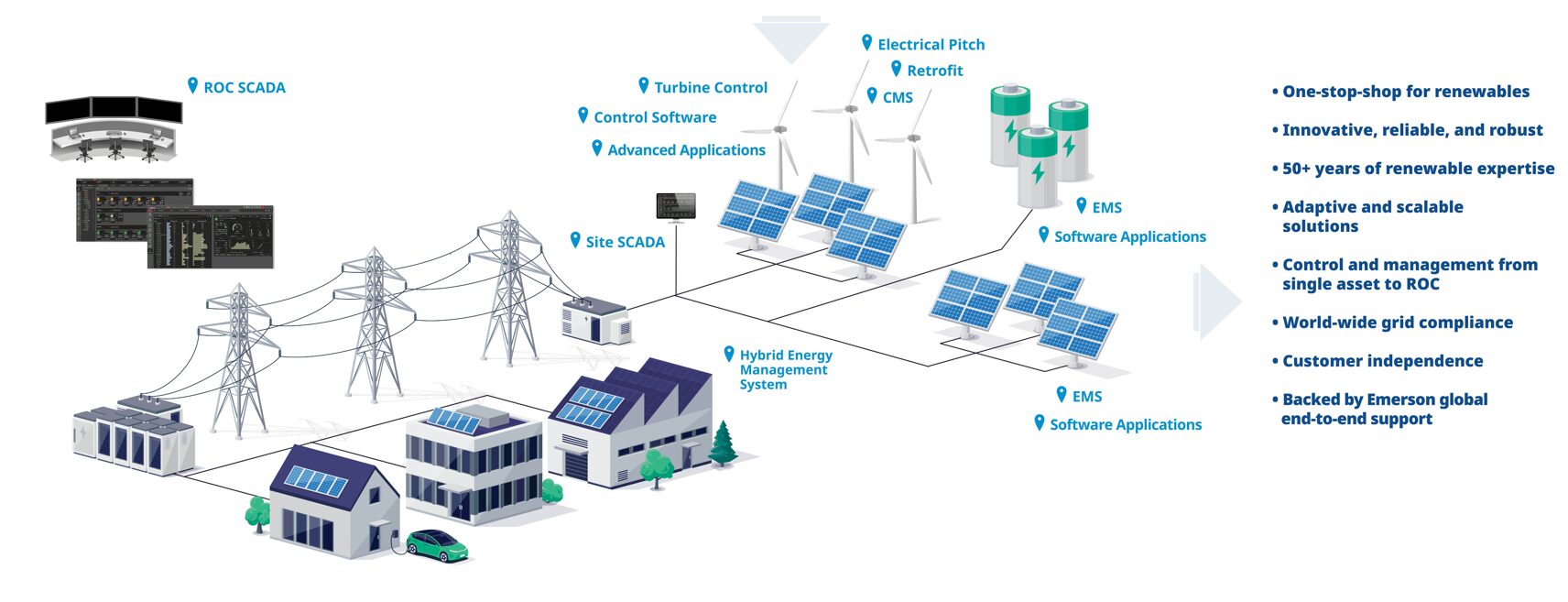
Here’s a view of the Ovation Green Wind solution portfolio.
Visit the Ovation Green section on Emerson.com for more on driving efficient wind energy solutions.