
There is no shortage of content these days covering the rapid rise of artificial intelligence (AI), both in the world in general and across industrial manufacturing. AI is exciting, and will unquestionably create a paradigm shift in decision making, industrial acceleration, workforce upskilling and mobility, and more automated workflows in the years ahead.
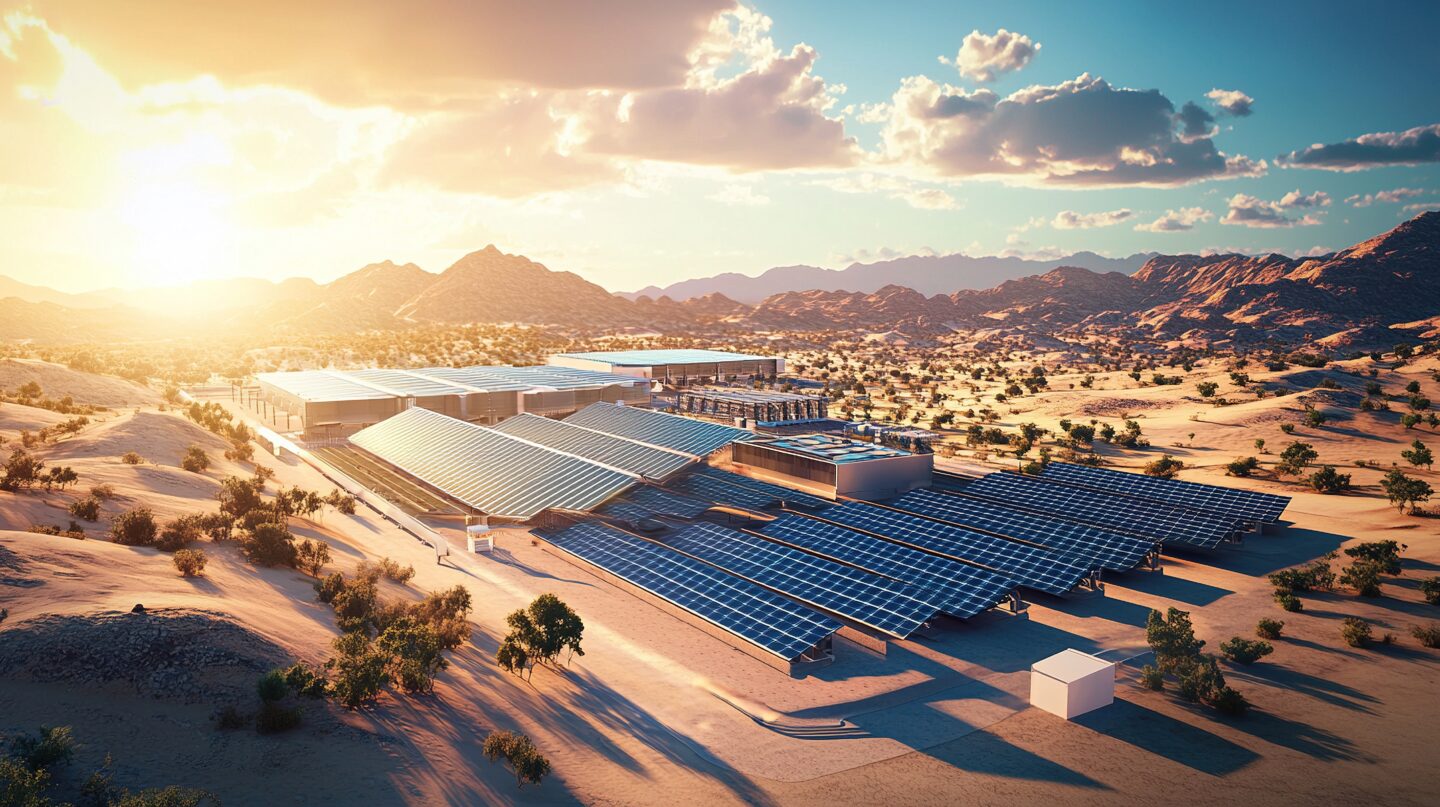
But another, related concept is starting to generate buzz as well: the hyperscale data centers needed to power the AI revolution. Continuous delivery of AI services and the training needed to build and improve the models requires tremendous amounts of power consumption, putting hyperscale data centers in a challenging position. As Emerson’s Brett Benson explains in his recent article in Solar Power World, these facilities typically consume 100 megawatts of power or more—and in doing so, need to guarantee 99.995% uptime per year.
Meeting these requirements is a challenge for sites hoping to offset some of their generation capacity with renewable energy sources like PV solar. That challenge is further complicated by the speed at which the facilities are being built. Brett explains,
“Hyperscale data centers, however, are currently under extreme pressure to engineer and build workable, incredibly stable facilities quickly, and as a result, they tend to focus less on renewables as part of their energy portfolio as renewables provide more intermittent power than traditional sources.”
Yet as hyperscale data centers become more commonplace, there will likely be increased pressure to shift more power to renewables, so the best possible plan for a new hyperscale data center is to implement automation technologies today that are built to seamlessly integrate renewable energy technologies when the time comes. That means selecting solutions built around an enterprise operations platform (EOP).
“Such a solution will help future-proof investments, providing more flexibility to shift power generation as new needs emerge.”
Succeeding with solar
When weather conditions are right, solar energy offers the lowest cost of generation possible. Unfortunately, weather conditions cannot always be optimal. This variability of production means any facility including solar generation will need to be prepared for flexible operation. Operations teams will need a solution to help them shift between generation types and operating strategies without needing to switch between many different software applications.
“Control software will need to connect to both solar and traditional generation assets, while seamlessly integrating with forecasting software to consider current and future conditions based on immediate and predicted weather, loads, and asset status.”
Fortunately, modern, green energy automation software solutions like Emerson’s Ovation™ Green help teams manage a wide variety of systems from a single, cohesive and intuitive dashboard. The software aggregates every traditional and renewable generation asset into a single pane of glass so that operators can see overall generation capacity and make critical decisions to maintain safety, uptime, and profitability. In addition, Ovation Green
“can also manage the high-speed control necessary for effective generation output control and critical load shedding, helping teams change operations quickly when they do not have enough power from generating assets.”
Ovation also offers digital grid management software to help teams determine future production requirements and make strategic energy decisions such as day-ahead energy purchases—helping them avoid the spot market to reduce energy costs.
Bringing it all together
Even if a hyperscale data center is not ready to bring renewables into the fold today, it will likely need some form of green energy in the years ahead as the facilities become more commonplace and expectations for more sustainable operation increase. Software like Ovation Green is designed as part of a seamlessly integrated EOP, making it possible to move data seamlessly from the intelligent field through the industrial edge and into the cloud, providing the flexibility necessary to easily add new solutions, fully integrated, without the need for extensive custom engineering.
It’s never too early to start the critical planning that helps future-proof operations.