
Given the high compositional variability of pipeline natural gas these days, it’s easy to understand why the number of gas chromatographs (GCs) and other analyzer technologies are growing at processing and custody transfer sites. Emerson’s Rosemount X-STREAM Enhanced XEFD Continuous Gas Analyzer and Rosemount 700XA Gas Chromatograph are prime examples. These provide a wide range of rich data, but there are many situations where such analytical depth is not necessary, and where operators want a simpler and non-invasive approach.
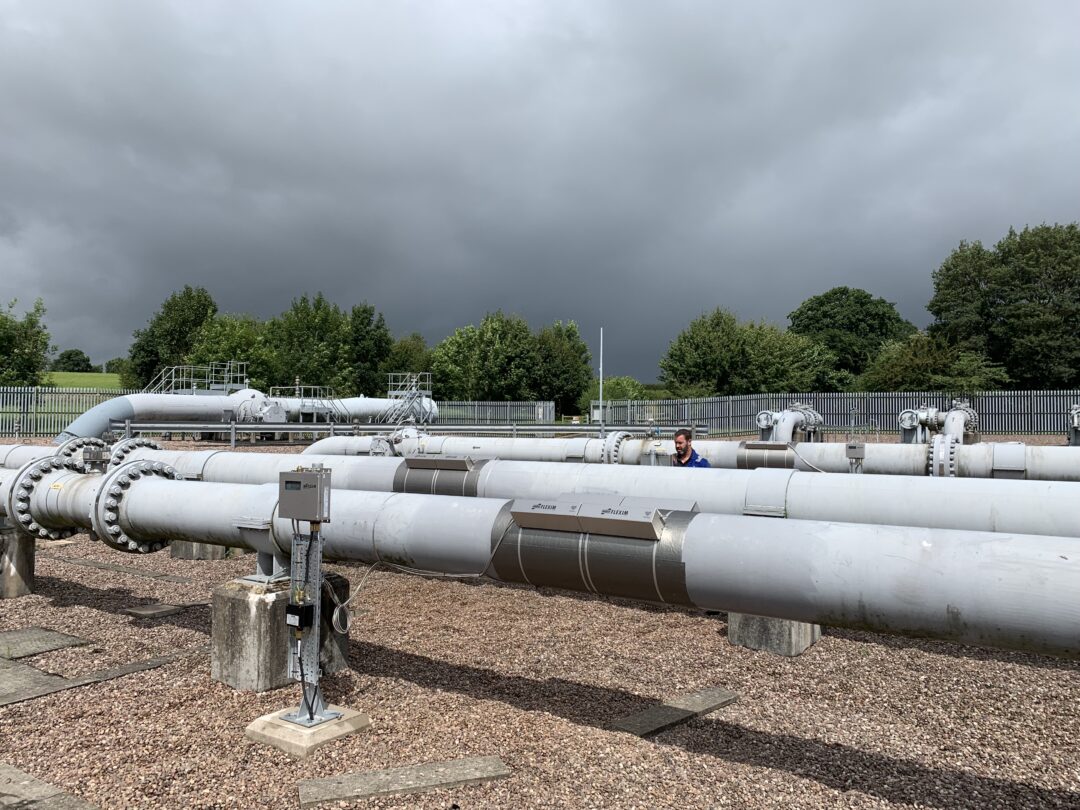
Here’s the answer: Emerson’s Flexim FLUXUS clamp-on ultrasonic gas flow meter with the Dynamic Gas Meter feature. How this works is the topic of our article in Pipeline & Gas Journal, Non-Invasive Flow Meters Measure Natural Gas Volume and Composition with No Process Penetrations.
We know that Flexim flow meters are highly versatile in many types of applications and require no process penetrations. But in addition to measuring natural gas flow, how do they also provide data on gas composition? It’s all about measuring the gas Z factor, which these meters measure in real-time:
Natural gas does not behave as an “ideal gas” because it deviates from what should be ideal characteristics. Since this is well understood, the degree of deviation is expressed as a compressibility factor designated as Z. In this context, an ideal gas has a Z factor of 1. Natural gas, depending on conditions and its composition, can show a Z factor below or above 1, with the exact factor providing direct insight into its chemical makeup. This is not quite as detailed and accurate as readings from a GC, but it is much easier to measure, and it can be done in real time in conjunction with flow measurement.
The article goes into more detail about how this works, but the critical point is that it provides the required accuracy and repeatability, making it an accepted measurement technique.
This technique is recognized and included in standards and studies from the AGA, the U.S National Institute for Standards and Technology (NIST), the Pipeline Research Council International, and other organizations.
The article also looks at three actual case studies:
- A European pipeline operator measuring BTU value in parallel with overall flow at various distribution branches.
- A pipeline operator monitoring BTU value and overall flow at the landfall point from offshore production platforms.
- A pipeline operator measuring turbine compressor bypass to control flow when running less than maximum.
As the range of gas supplies continues to grow, [Emerson’s Flexim] flow meters can provide information about gas quality at every point of the network, and they can observe new compositional changes, such as H2 concentration from green production sources. Clearly, this technology is well suited to the changing role of natural gas in new energy environments.
For more information, visit Emerson’s Flow Measurement Systems pages at Emerson.com. You can also connect and interact with other oil and gas industry engineers at the Emerson Exchange 365 community.