
Liquified natural gas (LNG) enables efficient transport of low-carbon energy, but its requirement to be kept at extremely low temperatures poses significant challenges for facility equipment and instrumentation. Our article in the April 2026 issue of Gas Processing & LNG, titled “Evolving pressure relief valve designs protect LNG facilities,” discusses new pressure relief valve (PRV) designs that protect LNG storage tanks, while providing cost savings through reduced fugitive emissions and increased capacity.
The role of PRVs in LNG storage
When natural gas is transported by ship, it is usually liquefied to increase its density, making maximum use of limited space. LNG storage at ports and on ships presents many challenges, including maintaining precise pressures and very low temperatures.
Relief valves for LNG storage tanks must fulfill particularly difficult requirements. They must be sized properly to allow for nearly instantaneous pressure venting or vacuum relief, preserve pressure within a narrow range, and minimize leakage.
Advanced PRV designs
Standard weight-loaded, low-pressure relief vents are typically a poor choice for LNG storage tank service because they usually have limited capacity, and they tend to leak as pressure approaches setpoint.
 In contrast, low-pressure pilot (LPP) relief valves minimize leakage by increasing the valve sealing force as pressure rises until the pressure setpoint is reached and the valve opens. Compared to standard PRVs, LPP valves can be set much closer to design pressure, minimizing release events and fugitive emissions.
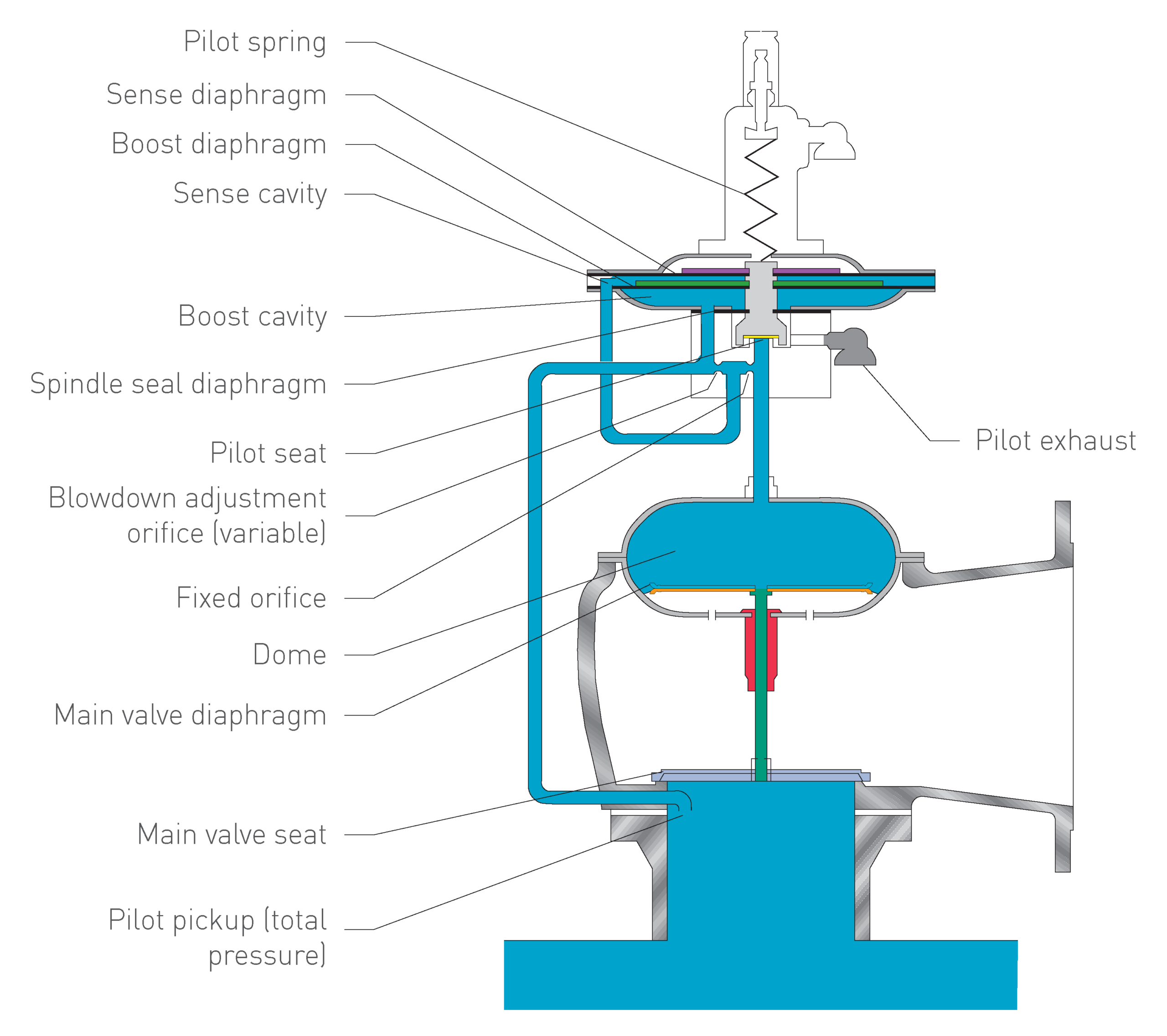
Recent LPP design upgrades feature double seats to further reduce leakage and prevent ice formation, and a new body design achieves extremely high flow capacities, enabling a single valve to protect very large tanks that would otherwise require multiple PRVs.
Vacuum protection and pressure transmitters
In addition to overpressure protection, many LNG storage tanks require protection against pressure vacuum that can occur when product leaves the tank.
Rather than install separate pressure and vacuum relief devices, a single PRV can provide both overpressure and under pressure protection, with a pilot-operated pressure setting and a weight-loaded or pilot-operated vacuum setting. This design saves on installation costs, and it has the same very high-capacity capability when operating in pressure or vacuum modes.
A multivariable pressure transmitter can also be added to monitor tank pressure and measure flows during valve relief events.
Case study
One LNG storage tank user was facing problems with PRV leakage and frequent vacuum relief events. Replacing the existing PRVs with a dual pilot valve and a multivariable pressure transmitter addressed both issues, dramatically reducing leakage and providing vacuum protection.

The ongoing visibility provided by the pressure transmitter also proved to be helpful during loading and unloading operations. PRV monitoring provided critical data for performing root cause failure analysis and optimizing maintenance schedules in this application.
Effective PRV options
Users needing to install or replace PRVs on LNG storage tanks can benefit from recent designs that offer minimal leakage, high capacity, and vacuum protection. Moreover, adding a pressure transmitter provides invaluable data that can help facilities maintain tank pressure and understand relief events more thoroughly.