
Why this matters now
As manufacturers push toward higher levels of operational excellence, many have adopted AI and machine learning technologies to close the gap between available resources and rising performance demands. These technologies have delivered step-change improvements, making them top of mind for most OT teams.
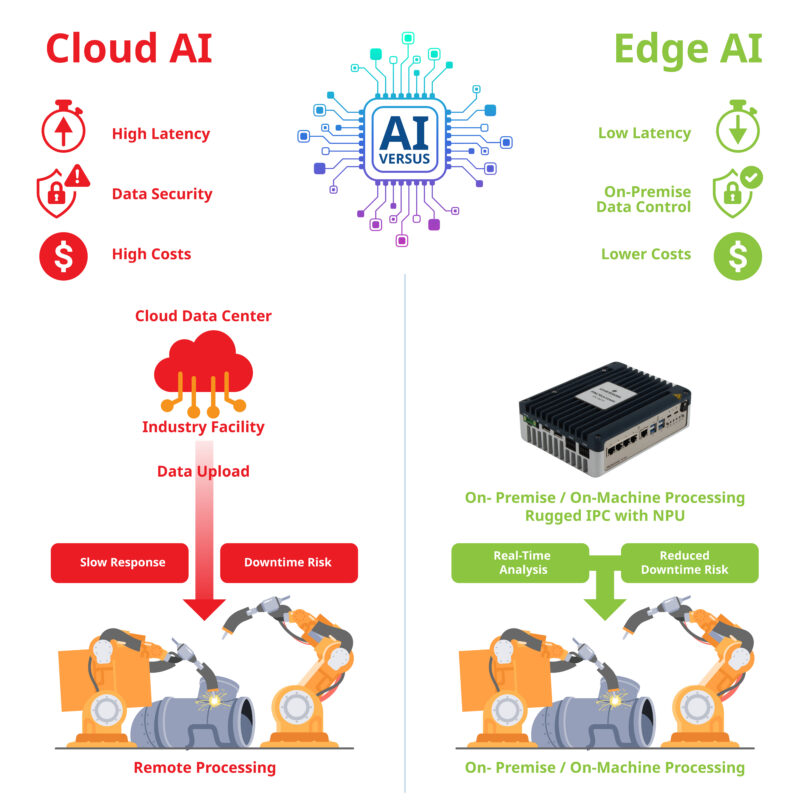
At the same time, many AI and ML solutions are assumed to require cloud connectivity due to their computational intensity. However, as industrial operations demand real-time feedback, deterministic behavior, and secure environments, cloud-only approaches increasingly fall short.
As Gene Juknevicius and Stephen Reichenauer explain in a recent article in Automation World, cloud adoption is not always practical for industrial AI:
“The typical cloud path is often impractical for industrial environments due to latency issues, poor connectivity, security constraints, and cost. The most efficient production lines demand real-time feedback loops, and cloud connectivity simply cannot deliver the required performance.”
The right answer in most industrial environments is a localized platform for compute-intensive workloads. More specifically, Emerson’s industrial PCs (IPCs), which can be equipped with dedicated AI acceleration—machine-learning-system-on-chip technology—to enable true, real-time autonomy for physical systems in the plant.
Takeaway: Industrial AI requires deterministic, low-latency execution that cloud architectures often cannot provide.
TL;DR
- Cloud-only AI architectures introduce latency and security challenges in OT.
- Industrial operations require real-time, deterministic feedback loops.
- Dedicated local compute supports AI inferencing at machine speed.
- Industrial PCs enable safe, scalable AI deployment on the plant floor.
- Local compute forms the foundation for autonomous industrial systems.
AI requires more than GPUs
AI performance is often associated with graphical processing units (GPUs), which are well suited for training large AI models. However, inferencing—the continuous execution of models on live data—presents very different requirements in industrial environments.
“Given limited power budgets, GPUs cannot process the item-per-second volume needed in industrial AI environments, such as when a camera is processing dozens of images per second. Dedicated edge AI processors handle high-speed computer vision and large language model inferencing with far greater efficiency. They meet the need for instant feedback to the controller with predictable, low-latency performance.”
Dedicated edge inferencing technology also delivers significantly higher power efficiency than GPUs—helping teams achieve both performance and sustainability objectives.
Takeaway: Industrial AI inferencing demands efficient, predictable, low-latency compute that GPUs alone cannot provide.
Built for purpose
Another major advantage of deploying AI at the edge is that industrial PCs are purpose-built for the environments in which they operate.
“Commodity computers struggle to meet the strict operating standards necessary on the manufacturing floor. Many industrial AI applications exist in harsh environments where heat, vibration, dust, humidity, and other environmental conditions shorten the lifespan of traditional hardware. IPCs are engineered to withstand these difficult environments, with ruggedized cases, fanless cooling, and soldered CPU and memory that help maintain nonstop operation regardless of installation location.”
Beyond environmental resilience, IPCs offer predictable performance and long hardware lifecycles, allowing teams to standardize platforms across years of operation as AI capabilities grow.
Takeaway: Purpose-built industrial hardware ensures reliability, longevity, and determinism for AI workloads.
Partnering for success
Limited in-house AI expertise does not need to be a barrier to adoption. Juknevicius and Reichenauer emphasize the value of working with experienced automation solution providers who understand both AI and industrial operations.
“Today’s most advanced automation solutions providers bring considerable expertise in instrumentation, integration, and long-term support needed to implement industrial AI. Many also maintain extensive AI expert partner networks, enabling them to act as trusted partners in executing AI strategies.”
By partnering with Emerson, organizations can assess requirements, select appropriate industrial AI tools, and deploy them effectively—while receiving lifecycle support and user training over time.
Takeaway: Trusted partners help industrial teams deploy, scale, and sustain AI capabilities effectively.