

TL;DR
- Effective digital platforms are essential to green hydrogen production projects.
- Flexible automation supports changing design requirements and project scaling.
- Emerson’s industrial automation architecture provides dependable performance, the ability to support native C programming, and protection of intellectual property.
- Effective HMI/SCADA delivers unified visualization, alarms, and analytics to optimize hydrogen production.
- Tightly integrated automation and visualization accelerate the development, startup, and optimization of green hydrogen systems.
Propelling pilot project success
Green hydrogen production is moving from pilot demonstrations to industrial deployment, and the transition depends as much on digital automation as on electrolyzer technologies. For example, Shanghai Bright-H Technology Co, Ltd in Shanghai, China is using Emerson’s advanced control and visualization architecture to scale alkaline water electrolysis from R&D toward full-scale systems capable of production rates reaching 2000 Nm3/hr and above.
Emerson’s Chiara Ponzellini, Movicon sales manager, describes in her Global Hydrogen Review June 2026 article titled Intelligent Controls Accelerate Large Scale Hydrogen Production how sophisticated control technologies, a visualization/data platform, and development services—all provided by Emerson—helped accelerate the design and enhance process performance.
Designing tomorrow’s hydrogen generation systems
Shanghai Bright-H develops multiple electrolyzer platforms, including proton exchange membrane (PEM) and alkaline (ALK) systems, while also investigating emerging approaches, such as anion exchange membrane (AEM) and solid oxide electrolyzer cell (SOEC). For this ALK project, the central challenge was not simply producing hydrogen efficiently but also doing so across varying operating conditions—while maintaining safety, stability, and responsiveness.
In this case, alkaline electrolysis posed especially difficult control problems because of nonlinear interactions among process variables and significant time delays. Those dynamics made conventional PLC strategies insufficient for maintaining optimal performance.
To address this and related issues, the company needed a robust automation platform capable of implementing sophisticated control algorithms, with the flexibility to adapt to changing design requirements, and to scale reliably from pilot installations to larger production assets.
Takeaway: OEMs and design firms require capable digital technologies to support advanced process development.
Applying innovative digital technologies
The Shanghai Bright-H team sought a proven supplier of both products and services to streamline design and deployment efforts. They selected an Emerson architecture built around PACSystems CPE215 controllers, PROFINET-connected RSTi-EP I/O, and the Movicon.NExT HMI/SCADA software platform.
A key differentiator was the controller’s support for native C programming, which supports embedding proprietary advanced control algorithms directly in the automation layer, while protecting intellectual property.
Engineers could fine-tune this aspect of the design, confident in the native operational performance, and assured that their intellectual property remained protected.
Takeaway: State-of-the-art processes benefit when IT-centric programming languages can be hosted on and executed by industrial-grade platforms.
Achieving complete visibility
On the operator side, the HMI/SCADA environment delivered more than visualization as it supported alarm management, historian functions, machine-level interfaces, control-room views, parameter tuning, and access to the performance data needed for continuous process improvement.
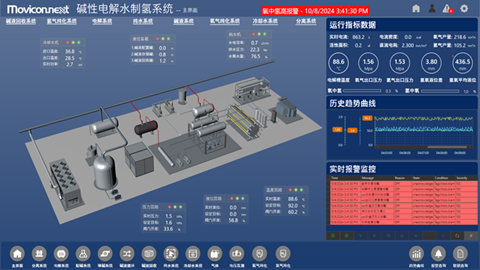
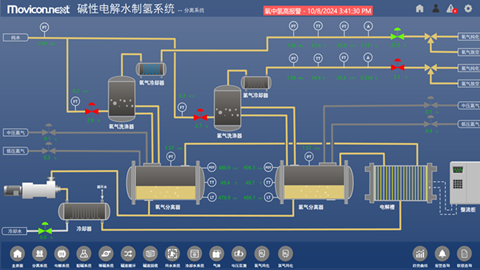
This digital solution provides unified real-time control, data visualisation, and performance analytics, enabling operators to monitor key process indicators (KPIs), including hydrogen purity across all electrolysis stacks. The 3D visualisation and predictive alarms also provided a great deal of clarity, which empowered their engineers to anticipate anomalies and optimise production efficiency.
Takeaway: Effective SCADA provides not only clear graphics, but also many supporting capabilities, such as predictive alarming and performance analytics.
A unified digital strategy supports next generation hydrogen systems
This unified digital platform improved commissioning speed, reduced startup complexity, and gave engineers real-time visibility into key process indicators such as hydrogen purity across electrolysis stacks, helping operators identify anomalies early and optimize operation under dynamic loads.
Next-generation hydrogen systems require tightly integrated control, visibility, and data capabilities to move efficiently from laboratory concepts to commercially viable production. For green hydrogen projects, intelligent automation is a core enabler of scale, reliability, and economic competitiveness.
Takeaway: Emerson is an experienced supplier of leading PLC and HMI/SCADA solutions, providing hardware, software, and integration services to help end users accelerate deployments of complex process automation systems.