
TL;DR
- Industrial AI requires compute closer to the process.
- Commercial servers are not designed for real-time OT needs.
- Deterministic performance is critical for control systems.
- Thermal constraints can impact edge performance.
- Modern edge controllers combine control and compute functions.
Why this matters now
As artificial intelligence (AI), machine learning (ML) and analytics applications become increasingly important contributors to competitive advantage in modern industrial operations, many organizations are coming to realize that they need increased compute capability closer to the edge. However, as Emerson’s Manish Sharma explores in a recent article in Control Design, commercial servers are rarely the best delivery method for that enhanced capability.
Today’s most effective operations teams are looking to modern, high-performance edge controllers to run real-time PLC logic and powerful edge software side-by-side. Fit-for-purpose industrial controllers are designed to handle both complex workloads and the challenging environments necessary in industrial operations.
Takeaway: Industrial AI requires edge architectures that deliver deterministic control alongside advanced compute capability.
A very specific architecture
Deterministic performance is critical in real-time operations. Operators rely on their systems to meet guaranteed benchmarks for control tasks—a challenge that is only becoming more important to navigate as modern applications like AI-based vision systems become critical tools for optimization. To meet these goals, forward-thinking organizations are implementing systems like the PACSystems™ RX3i. Sharma explains,
“The PACSystems RX3i can handle microseconds of deterministic performance on the VxWorks operating system. This is critical for modern applications like motion to reduce jitter. One thing that makes Emerson’s edge controller unique is that the PACSystems runtime for PLCs and the PACEdge software operate in parallel in the same system. Two cores run the runtime, and two run the PACEdge software without additional licensing. It’s an intuitive, cybersecure, out-of-the-box solution that provides both control and edge capability.”
But why is this specific system so valuable? As Sharma explains, the more work the processors must perform, the more the system is going to heat up. This can cause problems in systems not designed for industrial applications,
“Often, to offset this, edge controllers will de-rate the CPU when the system reaches high temperatures, trading performance for temperature control. This can cause cycle overruns, timing issues, and other problems when units are operating in the field, thereby limiting either the performance of the application or the choice of deployment at particular applications.”
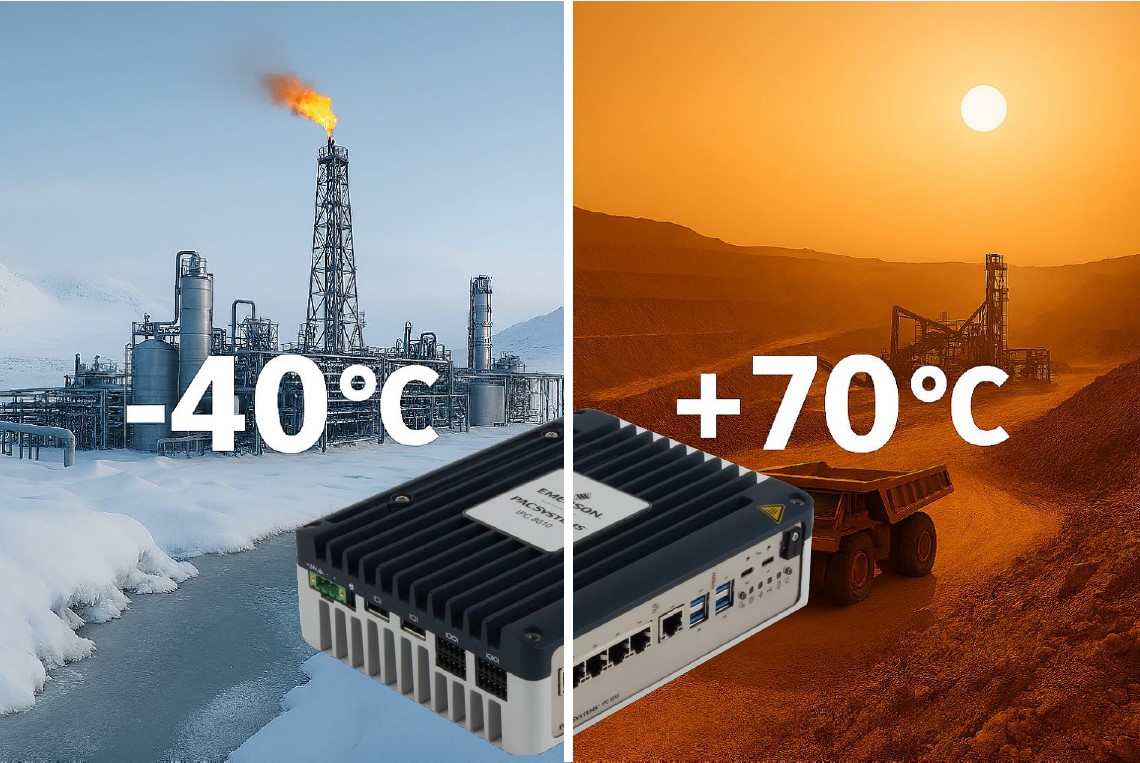
Emerson’s industrial PCs (IPCs) are the ideal fit for these circumstances. Designed to withstand temperatures from -40 to 70 degrees Celsius with no de-rating of performance or physical deterioration of the hardware, fit-for-purpose IPCs can run nearly anywhere and still provide reliable performance over the entire lifecycle.
Takeaway: Purpose-built industrial systems avoid performance degradation under real-world operating conditions.
Integration is key
As organizations strive to increase operational efficiency, data has become a critical enabler. Digital transformation led to digitalization of many operational strategies, but it also often led to a wide array of disparate systems, each creating, managing, and delivering data via proprietary methods. The result has been data silos, making it difficult to move contextualized data from the intelligent field, through the industrial edge, and into the cloud.
Emerson’s enterprise operations platform (EOP), built on a Boundless AutomationSM vision, has been critical to helping organizations break down silos and unlock seamless data mobility across individual facilities and the enterprise. Emerson’s edge control is a key part of that strategy of data democratization, “Using the most advanced edge controllers, it is even easier to integrate systems than with traditional PLCs. Today the systems use data formats that are easy to implement into software like SCADA, MES, cloud platforms and more. Now, the data is put into a format that is easy to use. Moreover, today teams can connect from the edge side of the controller securely and directly to cloud platforms.”
This integration enables seamless data mobility while preserving system security and performance.
Takeaway: Modern edge solutions enable secure, seamless integration between control systems and enterprise platforms.
Balancing performance and connectivity
Advanced edge architectures allow organizations to achieve both real-time control and modern data connectivity without compromise.
Takeaway: Edge-native architectures enable organizations to scale AI while maintaining operational integrity.