
Technology, markets, and customer needs continue to evolve across the power and water industries. In his keynote presentation at the Ovation Users’ Group conference, Bob Yeager, President of Emerson’s Power and Water Solutions business, discussed how staying relevant requires continuous transformation, close customer collaboration, and a willingness to embrace new technologies.
Why It Matters
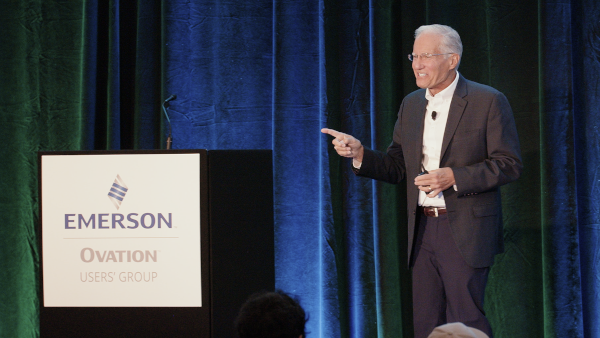 Project and process engineers are operating in an environment where technology is advancing rapidly and business demands continue to change. Bob emphasized that customers are diversifying their operations and looking for technology partners that can help them stay competitive. He also stressed that customer feedback has played a central role in shaping the direction of Emerson’s power and water solutions business over many years. For engineers responsible for reliability, modernization, and future planning, staying relevant means understanding where technology is headed and how it can be applied effectively.
Key Takeaways
- Emerson’s Power and Water Solutions business has transformed its portfolio through five acquisitions since 2010, including companies focused on wind turbine controls, hydro generation, turbine controls, excitation controls, and transmission and distribution.
- Bob described generative artificial intelligence as the biggest breakthrough in computer science in 25 years and a technology that is here to stay.
- Ovation is used in 50% of United States generating capacity and 50% of United States water treatment operations.
- Ovation systems are also deployed in more than 100 operating nuclear plants around the world.
- Artificial intelligence capabilities in Ovation 4.0 are being designed to support operators through virtual advisors and specialized agents that can be trained using plant-specific information.
Staying Relevant Through Transformation
Bob framed his presentation around the conference theme, “Agents of Change,” and reflected on how dramatically the business has evolved over the past decade. He noted that the organization was once heavily focused on fossil fuel generation but recognized the need to transform in order to remain relevant to its customers. Since 2010, the business has expanded through acquisitions in renewable and grid-related technologies, helping broaden its capabilities across the power and water sectors.
The driving force behind that transformation has not been change for its own sake. Instead, it has been a response to customers whose businesses are changing quickly and who need technologies that help them remain competitive. He said Emerson’s responsibility is to monitor technology trends and integrate those advancements into products and solutions that customers can use effectively.
The theme of partnership appeared throughout the presentation. Bob described the relationship between Emerson and its customers as one built on collaboration, long-term relationships, and shared responsibility for keeping critical operations running. He emphasized that customer guidance has helped shape the company’s direction over many years.
A Broad Presence Across Traditional, Renewable, and Nuclear Power and Water
Bob highlighted the scale of the installed Ovation Automation Platform base across multiple industries. He said the Ovation platform now supports 50% of United States generating capacity, representing 600,000 megawatts, and 50% of all water treatment in the United States, representing 12 billion gallons per day.
For water and wastewater organizations, he noted that many projects span entire metropolitan areas and often continue for decades. These long-term relationships have led Emerson to establish local offices in cities where large water projects are being executed.
Bob also discussed the company’s position in nuclear power. He said Ovation systems are installed in more than 100 operating nuclear plants worldwide and supports both primary and secondary plant applications. He pointed to the company’s long-standing relationship with nuclear operators and the Westinghouse nuclear team as an important part of that history.
Artificial Intelligence Moves Into Operations
A significant portion of the presentation focused on artificial intelligence and the role it could play in future plant operations. Bob described generative artificial intelligence as a major breakthrough in computer science and said the technology is becoming increasingly pervasive. He positioned Ovation 4.0 as an example of how these capabilities can be integrated into industrial operations.
He explained that the large language model used within Ovation systems runs on a server on the plant network rather than requiring operational data to be sent to a cloud-based system. The model can be trained using plant-specific information such as turbine documentation, valves, transmitters, signal diagrams, application data, and historical information.
The objective, according to Bob, is to create an intelligent assistant capable of helping operators diagnose and understand both control system behavior and process conditions.
From Virtual Advisors to Specialized Agents
To illustrate the concept, Bob presented two operating scenarios involving a large data center supported by gas turbines and battery systems. In the first scenario, operators responded to a gas turbine trip using traditional procedures. In the second scenario, a virtual advisor provided early warnings, startup recommendations, dispatch guidance, and battery status information that supported much faster recovery.
He also described a future capability that would allow users to create specialized artificial intelligence agents. In the demonstration, an agent was proposed to learn from an operating event and provide earlier warning of similar conditions in the future. Bob compared the process of building agents to the way users currently create control logic, describing it as a new approach to building and applying operational knowledge.
As he concluded, Bob returned to the conference theme and encouraged attendees to continue adapting to technological change. For power, water, and wastewater professionals, his message was straightforward: staying relevant requires continuous learning, strong partnerships, and thoughtful adoption of new technologies.
To learn more about the community of Ovation users and upcoming activities, visit the Ovation Users Group website.