
Distillation columns are often the most capital-intensive and operationally critical equipment in a process, and process engineers and chemical engineers make size and configuration decisions early, when information is thin. In an on-demand webinar, Emerson’s Irina Rumyantseva, AspenTech Senior Principal Solutions Consultant, and Salimzhan Kabylbayev, AspenTech Product Manager, showed how Aspen Plus® Process Simulation Software supports those decisions from property selection through feasibility analysis, column design, and operability assessment.
Why It Matters
Column design balances thermodynamics, hydraulics, internals, energy use, and cost, usually before much plant or lab data exists. Errors at that stage don’t stay small. A 5% error in phase-equilibrium predictions can lead a model to call for double the trays actually required, and that error compounds as the project moves from desk study to lab, to pilot, to installed equipment. Validating the thermodynamic foundation before committing to geometry protects both capital spend and long-term operability.
Key Takeaways
- Physical properties set the ceiling on every downstream result, so method selection, parameter completeness, and data regression come before sizing any column.
- Binary and ternary analysis show what separation is feasible and how azeotropes respond to pressure changes and entrainers.
- The ConSep (Conceptual Separation) block screens reflux ratios, stage counts, and feed locations, then converts directly to a RadFrac model with generated estimates.
- Hydraulics, vendor tray data, stage efficiencies, and rate-based methods turn a conceptual model into a usable digital asset.
- The most common design failure is a violated mass balance, infeasible specifications followed by the wrong choice of degrees of freedom, and distillate-to-feed ratio errors.
Physical Properties Set the Ceiling on Everything Downstream
Distillation is about capturing vapor-liquid equilibrium (VLE) and vapor-liquid-liquid equilibrium (VLLE), and directing it efficiently, so a model is only as good as the thermophysical foundation under it. Irina made the cost case plainly. A 5% error in vapor-liquid equilibrium predictions can double the predicted tray count, a multi-million dollar mistake, and that error compounds with project stage. Early on, correcting it entails checking the model against literature. If left uncorrected, at pilot scale and beyond, it can lead to ordering the wrong equipment, with both an oversized vessel and the operating problems that follow.
Aspen Plus offers several ways to check that foundation. The Methods Assistant guides package selection through a decision tree, and the binary interaction parameter completeness display shows which parameters are present and where they came from. Built-in parameter completeness checks help engineers verify the physical property foundation before committing to design decisions. Aspen Properties can pull data from NIST and other built-in sources, which hold more than five million sets of experimental data. Package choice is system-dependent. Non-random two-liquid (NRTL) models work well for highly non-ideal systems but fail at high pressure; Cubic-Plus-Association and perturbed-chain methods handle association and high pressure; and Peng-Robinson is the general option for hydrocarbons.
Map What Is Feasible Before You Commit to a Design
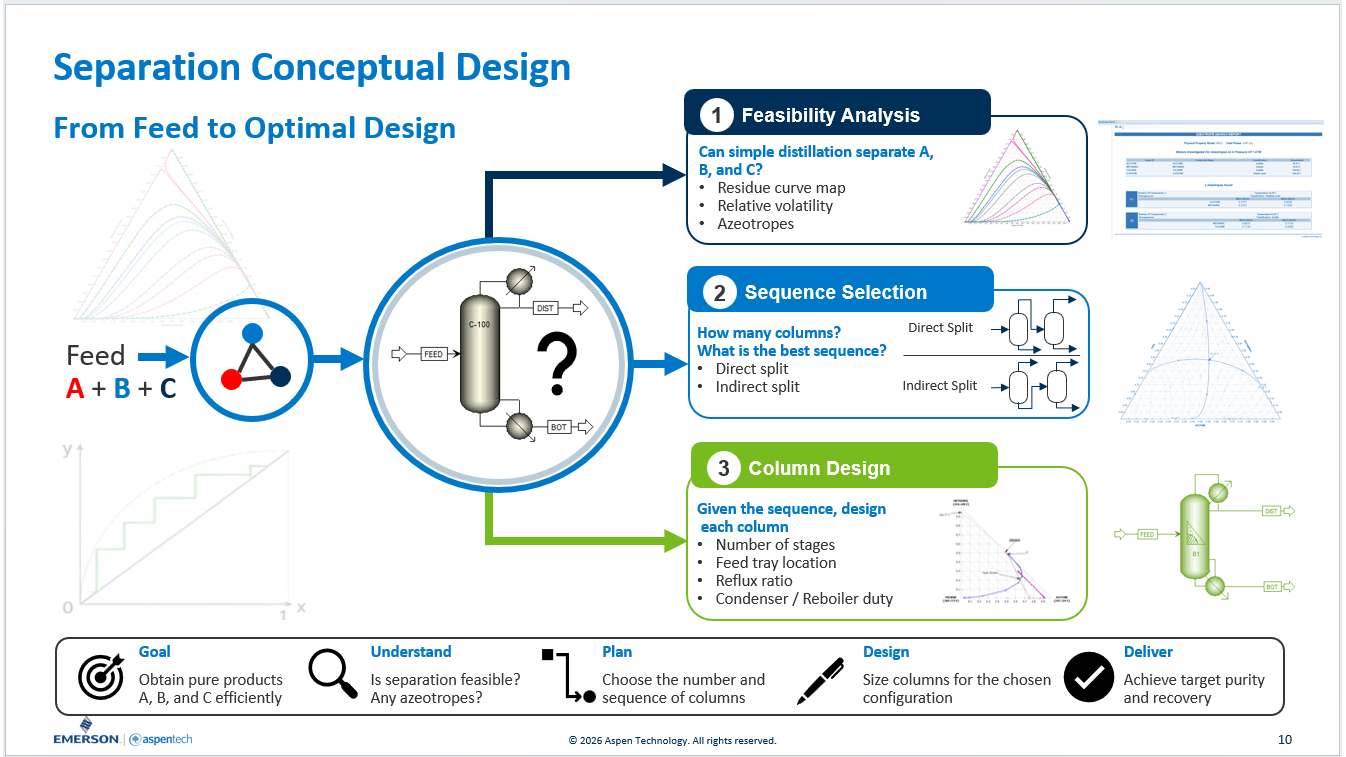
Before committing to a column design, engineers need to understand what separations are physically achievable. The Aspen Properties environment provides tools to gauge feasibility. For example, temperature phase-equilibrium liquid composition diagrams reveal where azeotropes are located and how far they shift with pressure, helping engineers determine whether the desired separation is achievable through conventional distillation or whether an alternative approach may be required. A pseudo-binary system shows how an entrainer changes that behavior, including whether it makes the separation harder. Lastly, the ternary distillation synthesis map adds residue curves, distillation boundaries, and the unstable node, stable node, and saddle points that define achievable products. Plotting the feed composition and the mass balance line shows which products can be recovered overhead and what remains in the bottoms.
Screen Concepts Quickly, Then Go Rigorous with RadFrac
The ConSep block sits between a component mixture and a rigorous column model, and it is where most early iteration should happen. It manages degrees of freedom automatically and plots the rectifying and stripping lines against the residue curves, helping engineers screen column configurations before moving to rigorous modeling.
After screening the separation in ConSep, the converged model can be converted directly to a RadFrac model with generated estimates, providing a starting point for rigorous column design. Irina advises working through each form to confirm that the model aligns with the intended design, including verifying whether a distillate rate or distillate-to-feed ratio is the appropriate specification and whether azeotropic convergence methods are required. She also shared additional best practices for rigorous column design, including using sensitivity analysis to evaluate the impact of feed-stage location on distillate purity and reboiler duty, as well as techniques for troubleshooting convergence issues.
Hydraulics, Internals and Plant Data Turn a Model into an Asset
Once the column converges, hydraulics determine whether the design is buildable and operable. Aspen Plus sets up hydraulic sectioning automatically and includes a broad range of commercial and custom trays and packings from Koch, Raschig, Sulzer, and Montz.
As designs become more detailed, engineers often revisit assumptions that were appropriate during early screening. Stage efficiencies default to perfect equilibrium at every stage, which may be reasonable for simple separations or when no better data exists, but real columns rarely behave that way, so specifying efficiencies by section is part of tuning. Equilibrium methods can also break down where heat and mass transfer limit performance, such as with acid gas systems and reactive separations. In these cases, rate-based modeling can better represent column behavior. Asked which mistakes he sees most often, Salim was direct. The biggest is violating mass balance by specifying more mole flow out of the top or bottom than the feed contains, followed by degrees-of-freedom errors and skipping hydraulics.
Watch the full on-demand webinar, Designing Distillation Columns with Confidence Using Aspen Plus, for the demonstration and the full question-and-answer session.

