
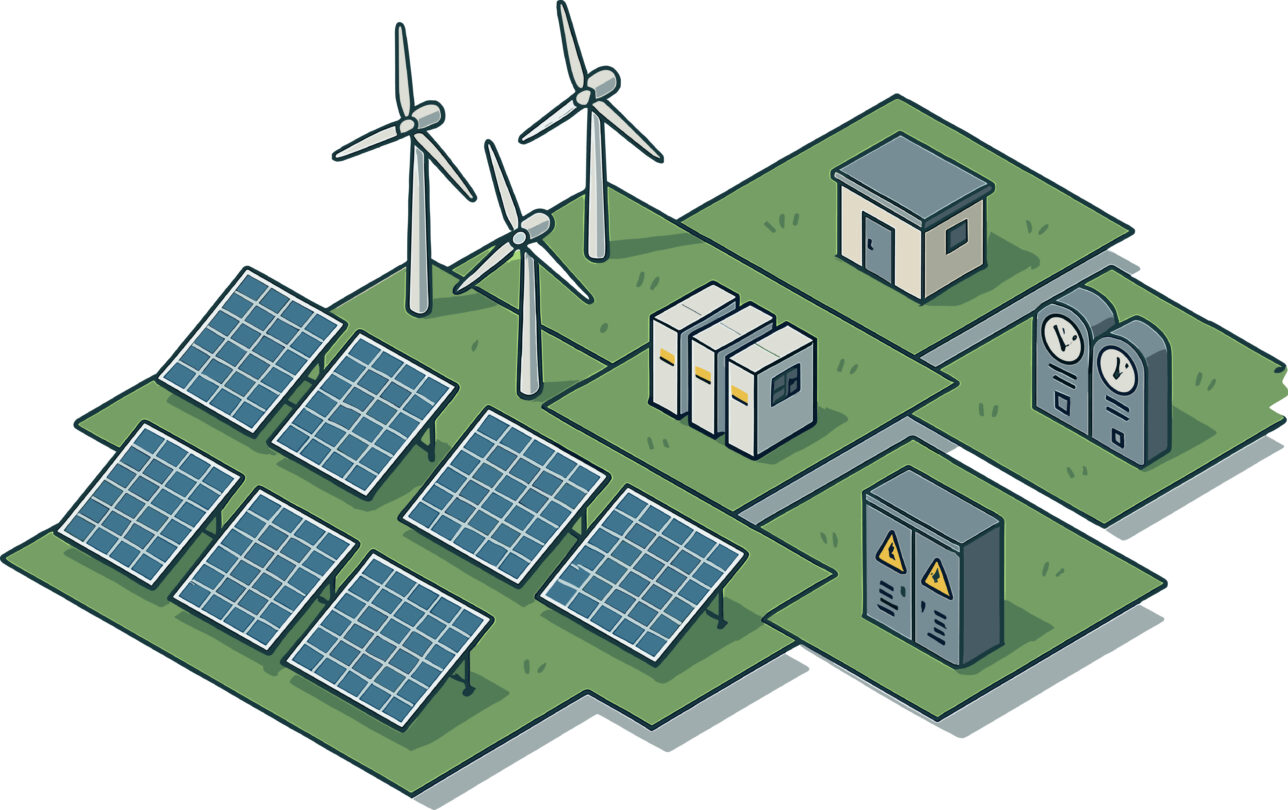
Modern society is facing two complex challenges emerging in parallel. On one hand, electrification around the globe is expanding at a mind-blowing rate. AI, personal electronics, electric vehicles, and more have dramatically increased energy consumption, and there seems to be no end in sight. At the same time, calls for a higher percentage of renewable energy generation on the grid have put power generators in a tricky position—they must produce more using a wider array of much more variable technologies.
In his recent article in North American Clean Energy, Ole Binderup explores this new trend. Today, he shares, many power generators are looking to acquire or build renewable energy farms, often with a mix of wind and solar photovoltaic (PV) generation. As they do so, they quickly realize that managing renewables isn’t the same as traditional generation,
“As operators add these assets, control becomes more complex, requiring new technologies to simplify and streamline operation.”
The solution, Ole explains, is to add hybrid power plant controllers (PPCs) to seamlessly integrate wind, solar PV, and battery storage for intuitive operation.
Control is complex
Bringing renewables online to contribute to the grid adds new challenges. Renewable energy generators—solar PV and wind in particular—are highly variable in their production. When the sun is shining and the wind is blowing, they can produce tremendous amounts of cheap power. But that production stops abruptly when the sun goes down or weather patterns shift.
Yet, regardless of a site’s production capability, the grid needs stability, and that responsibility falls to producers. Ole shares,
“Owners and operators of hybrid wind, solar and battery sites must manage their energy generation to assist and stabilize the grid, a task that becomes more complex as the organization adds more generation assets from a wide variety of different manufacturers. At that point, it becomes unwieldy to manage individual assets across the entire farm, or even across a collection of geographically dispersed and mixed renewable sites.”
Each type of generating asset must be controlled differently, using different software. Obviously, wind generation is not controlled in the same way as solar PV production. However, that’s just the beginning. Even within a single type of generation, operators may be responsible for many different makes of asset (turbines, inverters, etc.) which all have their own control system software and processes.
Just moving between all those different systems can be a lot of work and can create a lot of wasted time for operators trying to make the most of their production assets. Add in the fact that having many different interfaces means they must be trained across a wide variety of software, and the end result is a lot more time spent preparing and navigating than actually producing and optimizing.
A system for simpler operation
PPCs remove much of the complexity from operating renewable assets across a wide range of control technologies. Emerson’s Ovation™ Hybrid PPC is designed to optimize energy production, enhance efficiency, and maintain grid stability by integrating real-time monitoring, automated adjustments, and predictive analytics to better manage power output, and lower operational costs and complexity. Ole explains,
“When a team adds a hybrid PPC to their diverse farm of renewables, they can stop managing individual turbines and inverters and start seeing collections of assets as small power plants. For example, 100 wind turbines can be treated as a single generation plant, while another 50 megawatts of PV can be a separate generation plant, regardless of how the individual assets in each of those plants contribute to the overall generation.”
That means any combination of assets can be managed from a single point and through a single point of interconnection to the grid. Each Ovation Hybrid PPC can manage up to 2,500 assets, managing all the complexity on the back end to provide operators with a single, unified interface for all their generation.
A more flexible, sustainable future
As power generation organizations add new renewable production assets to meet sustainability goals, demand increases, and increasing regulation, they will need ways to help operators manage all those assets without increasing complexity to the point where efficiency and operational excellence begin to suffer. Modern hybrid PPCs and fit-for-purpose software help operators eliminate the complexity of integrating different assets, providing a single point of reference and control via an intuitive control system to let them focus on the high-value tasks that deliver value.