
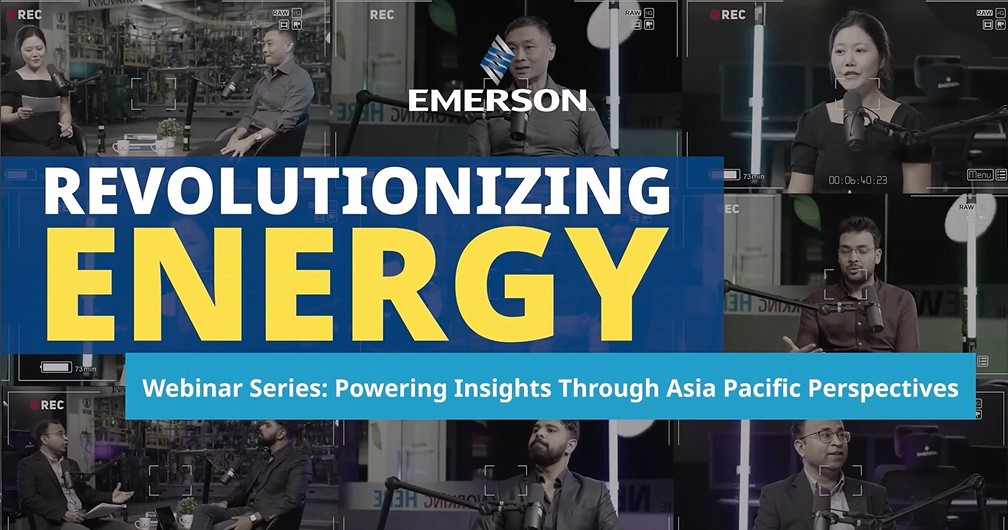
In the second episode of Emerson’s Revolutionizing Energy webinar series, Heeya Lee and Andrew Phang examined how integrated pressure regulation and gas conditioning shape reliability, efficiency, and lifecycle economics in gas-fired power generation. Their conversation focused on the Asia Pacific (APAC) market, where combined-cycle plants are scaling quickly, and fuel gas quality has become a decisive factor in turbine uptime.
Why It Matters
 Combined-cycle power plants pair gas turbines with a steam turbine to achieve roughly 60% overall efficiency, placing them among the most efficient large-scale generation technologies available today. Those gains depend entirely on precise fuel gas conditioning. Andrew cited industry data showing that 70% of unplanned power outages trace back to gas turbine issues, and nearly 30% of those failures are directly linked to poor quality fuel gas. For project engineers, fuel gas system design is not a peripheral concern; it is central to plant availability, heat rate, and lifecycle economics.
Key Takeaways
- Gas power is expanding in APAC because it is the only scalable, dispatchable, and low-carbon option that can meet rapid demand growth, support renewable expansion, and accelerate coal displacement without compromising grid reliability.
- Even small deviations in liquids, particulates, sulfur compounds, pressure, or temperature can degrade turbine efficiency, shorten maintenance intervals, or trigger derates and trips.
- Sourcing critical components from multiple suppliers creates a “zoo of devices” in which no single party owns full-system performance.
- Emerson’s integrated skid consolidates pressure control, safety isolation, filtration, and flow control under one original equipment manufacturer (OEM).
- Early engagement at the front-end and engineering design (FEED) stage reduces rework and schedule risk on first-of-its-kind projects.
Why Fuel Gas Quality Governs Turbine Uptime
Andrew described gas turbines as precision machines whose performance and reliability are highly sensitive to fuel gas quality. When gas is not conditioned precisely to specification, efficiency erodes, maintenance intervals shorten through fouling, corrosion, or blade damage, and control systems can initiate derates or trips.
In the worst case, the turbine shuts down, taking the entire combined cycle and potentially portions of the power grid offline. As he put it, the path to 60% efficiency runs directly through the fuel gas conditioning train, where clean, dry, pressure- and temperature-controlled fuel is foundational rather than optional.
The “Zoo of Devices” Problem
Heeya highlighted a pattern Andrew sees often in Southeast Asia: plants buy individual critical components from different suppliers and try to string them together. Each part may meet its own datasheet, but no one owns the whole system. When gas quality drifts, liquids break through, pressure fluctuates, or response lags, accountability disappears. Emerson’s answer is total ownership across the fuel gas skid, shifting the model from component-level compliance to full integrated system performance.
Four Pillars Inside the Integrated Skid
Andrew walked through the four functional pillars engineered for the high turndown and fast response that daily deep cycling and renewable integration demand.
- Pressure control: Axial Flow Regulators deliver high capacity in a compact footprint, with a fully balanced trim that achieves ±1 % pressure accuracy across wide flow and pressure swings.
- Safety and protection: BM Series slam-shut valves provide fast, positive isolation under abnormal pressure conditions, and a protected soft-seat design keeps the seat out of the gas flow to prevent erosion and wear.
- Filtration: Optimized filter separators and knockout drums remove 99.7% of particulates down to one-third of a micron, at reduced skid footprint and weight.
- Flow control: The FLV electrically actuated control valve provides accurate, repeatable fuel gas control across load changes with zero bleed actuation, supporting methane emissions reduction and Environmental, Social, and Governance (ESG) requirements.
Execution: Bangladesh, India, and China
Andrew shared a landmark project for a Korean engineering, procurement, and construction (EPC) contractor delivering its first mega power project in Bangladesh. The scope carried a tight schedule, continuously evolving end-user specifications during design, and high regulatory scrutiny.
Emerson engaged early at the FEED stages, aligned the design in real time as requirements evolved, and leveraged local execution track record to build regulator confidence. The project also marked the first deployment of the BM9 10-inch slam shut valve. Similar patterns played out on a fertilizer plant in India and a 920-megawatt plant in China.
Combined with the Chengdu- and Singapore-hub-based Asia-to-Asia strategy, OEM ownership enabled Emerson to customize skids faster, absorb late-stage changes, and remove multi-vendor interface risk, resulting in fewer handoffs, faster approvals, and greater schedule certainty for EPC and end-user teams.
Watch the Full Conversation
For a deeper look at how an integrated skid approach can strengthen your next gas-fired project, watch the full Revolutionizing Energy session with Heeya and Andrew here: Integrated Gas Conditioning Skid System and the Path to Better Plant Performance.