
As governments, industries, and investors converge on net-zero strategies, carbon capture and sequestration (CCS) has emerged as a necessary tool—not just to limit future emissions, but to actively remove and store existing CO₂ for the long term so it no longer poses a threat. However, scaling CCS from promising pilots to global infrastructure hinges on solving three interconnected challenges: fiscal monitoring, composition and purity assurance, and pipeline integrity.
At the heart of each challenge lies one constant: measurement instrumentation. Without robust, verifiable measurement technologies, the economic, environmental, and regulatory viability of CCS collapses. From custody transfer to leak verification, instrumentation is the infrastructure behind the infrastructure.
Fiscal Monitoring: Proving Accountability in Every Transfer
The most business-critical dimension of fiscal monitoring is financial accountability. Every metric ton of CO₂ captured and stored carries potential monetary value—whether through tax incentives, avoidance of emissions penalties, or tradable carbon credits. For emitters and operators, precise measurement is not just about operational control; it is the basis of contracts, billing, and credit allocation.
Any discrepancy in these measurements creates risk. Under-measurement forfeits eligible credits; over-measurement invites regulatory penalties and reputational damage. Even minor inaccuracies can lead to financial disputes, eroding the trust required for large-scale, multi-party CCS projects.
The solution for these challenges lies in direct mass measurement. Coriolis flow meters, such as Emerson’s Micro Motion™ Coriolis Meters, are uniquely suited to CCS conditions. They measure mass directly—eliminating compounded error from pressure, temperature, and volumetric conversions that can arise from other measurement techniques. Their design is resilient against CO₂ impurities, and Smart Meter Verification, an automated, in-process diagnostic that verifies complete meter health, allows operators to validate calibration in real time without removing the meter or interrupting flow.
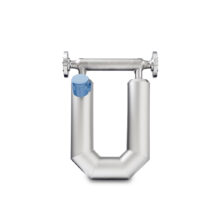
Micro Motion ELITE Coriolis Flow and Density Meters deliver accurate, repeatable flow measurement in challenging applications.
For regional hub projects where multiple emitters share pipelines, fiscal metering is even more vital. Each contributor must establish custody transfer points before injection. Totalized flow monitoring across booster stations provides verification that aggregated volumes remain consistent and that no unaccounted losses are occurring.
Fiscal monitoring is both a technical function and a trust mechanism. It transforms the invisible flow of CO₂ into accessible, auditable, and financially credible transactions.
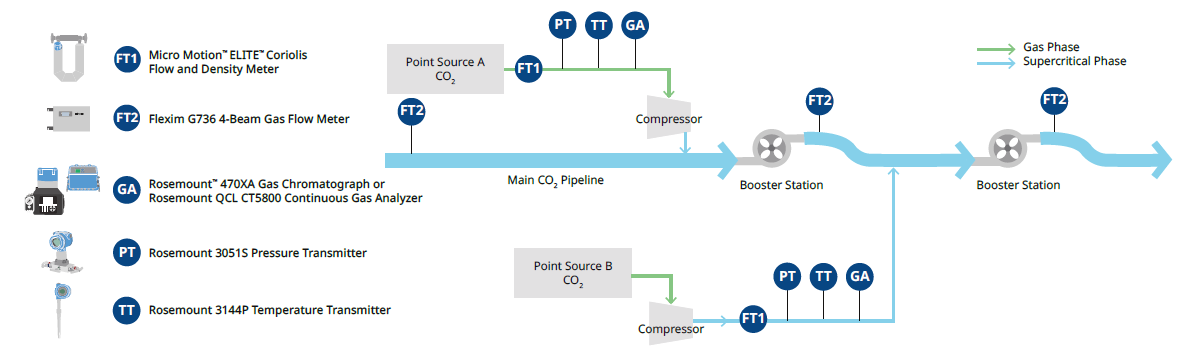
Here is a high-level overview of the injection process.
Composition and Purity Measurement: Guaranteeing Compliance and Credits
The business-critical question for CO₂ quality is regulatory compliance. Carbon credit programs and government incentives depend on the ability to verify that the gas being sequestered is, in fact, high-purity CO₂. Any dilution with impurities—water, NOx, SOx, or particulates—undermines both pipeline safety and credit eligibility.
For operators, this means gas composition must be analyzed not once, but repeatedly: before entering a pipeline, at custody transfer points, and upon delivery to storage facilities. Gas analyzers provide this assurance. The Rosemount™ 470XA Gas Chromatograph, alongside advanced analyzers using quantum cascade laser or chromatography techniques, offers high-resolution, real-time analysis capable of detecting trace contaminants.
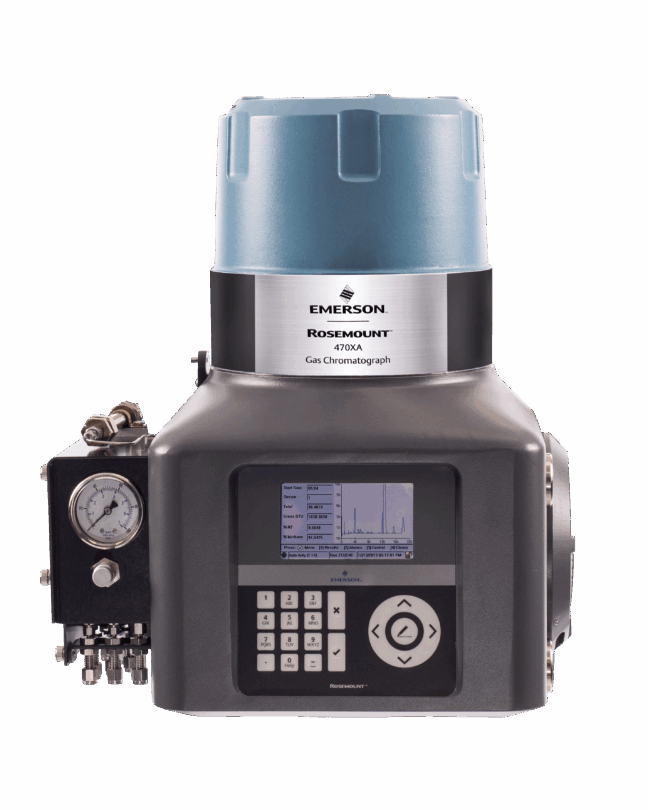
Rosemount 470XA Gas Chromatograph is designed to simplify gas analysis in fiscal and custody transfer applications.
The impact of these analyses extends beyond compliance. Impurities increase the risk of corrosion and leaks, shortening pipeline life and raising costs. In multi-source networks, one emitter’s lower-quality stream can compromise the entire system. Continuous analysis ensures that only compliant, stable, and credit-eligible CO₂ enters the infrastructure.
Composition and purity measurement also serve a dual function: protecting physical assets and securing financial certainty. Without them, neither operators nor regulators can verify that CCS is delivering its promised environmental and economic outcomes.
Pipeline Integrity: Verifying That Leaks Do Not Happen
Perhaps the most critical dimension of pipeline integrity is leak verification. CCS cannot tolerate the mindset of “detect and fix.” Unlike traditional energy infrastructure, where minor fugitive losses may be absorbed as operating risk, CCS pipelines exist for one reason: to permanently remove CO₂ from the atmosphere. Any leak—no matter how small—erases environmental gains and erodes public and investor trust.
To address this challenge, operators are adopting multi-layered leak assurance strategies to meet this zero-tolerance standard:
- Ultrasonic leak detectors, such as the Rosemount Incus Ultrasonic Gas Leak Detector, identify high-frequency acoustic signals from escaping CO₂. They remain reliable under variable weather and gas dilution, making them effective for custody transfer points and outdoor systems.
- Mass balance monitoring compares totalized flow across pipeline segments. Even small discrepancies between input and output volumes indicate a potential leak. Clamp-on flow meters like the Flexim™ FLUXUS® G736 4-Beam Gas Flow Meter provide a non-intrusive way to deploy these checks at multiple points along long pipelines.
- Redundant pressure and temperature sensors act as early warning systems. Sudden fluctuations signal instability in the supercritical CO₂ state, pointing to stress that could precede a breach.
Leak verification must be paired with corrosion and erosion monitoring, the underlying drivers of containment risk. When CO₂ mixes with water, it forms carbonic acid that corrodes steel. Impurities such as NOₓ and SOₓ accelerate this process, while entrained solids erode walls physically.
Rosemount Wireless Corrosion and Erosion Monitoring Transmitters provide continuous, non-intrusive measurement of wall thickness, transmitting real-time data via WirelessHART® networks and reducing the need for manual inspection.
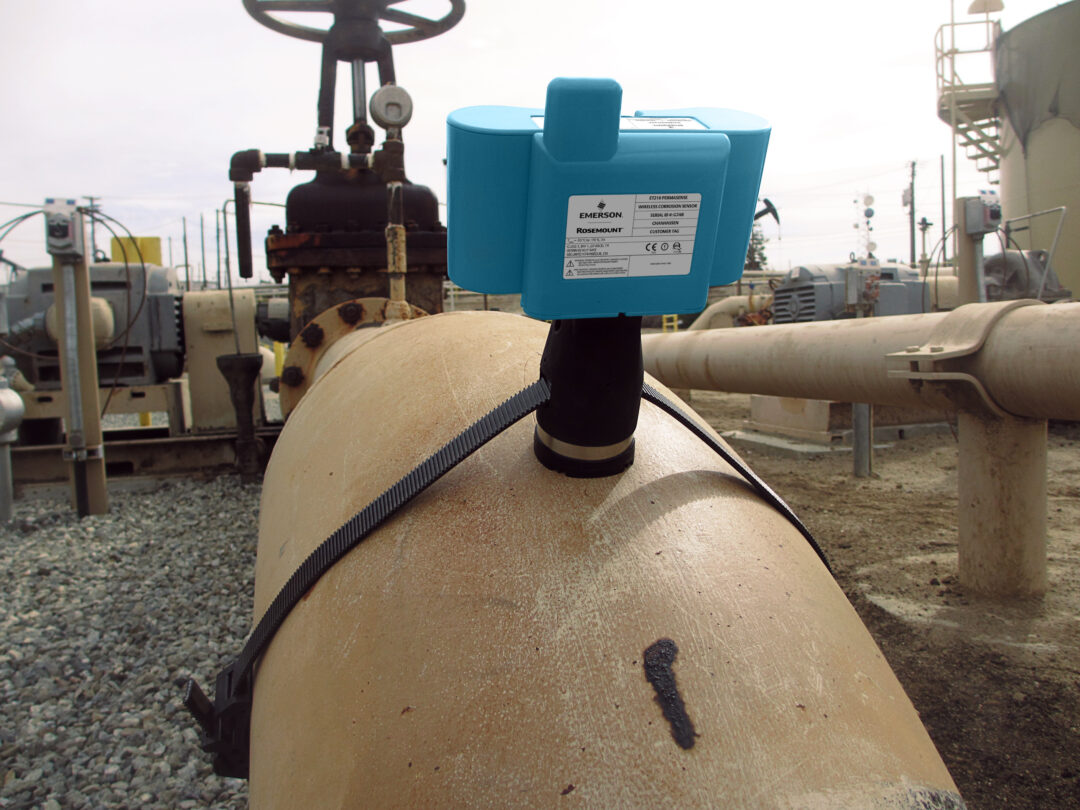
Rosemount Wireless Corrosion and Erosion Transmitters help ensure equipment integrity, preventing failures, leaks or ruptures that could compromise safety and environmental protection.
The combination of leak verification and corrosion monitoring creates an auditable assurance framework. Rather than simply responding to leaks, operators can demonstrate to regulators and stakeholders that no leaks are occurring at all. In CCS, where permanence defines success, this distinction is critical.
Building Trust in a Measured Future
CCS is complex and capital-intensive. Its promise depends not just on engineering or geology, but on trust. Trust that the CO₂ was captured. Trust that it was measured accurately. Trust that it was pure. And, above all, trust that it remains safely stored underground.
Measurement instrumentation makes that trust possible. It enables compliance, secures financial credits, and proves environmental integrity. Without it, CCS would be unverifiable—and ultimately uninvestable.
For stakeholders across the CCS spectrum—emitters, pipeline operators, regulators, and investors—the imperative is clear: invest in robust measurement strategies not as a support function, but as the foundation on which credible, scalable, and sustainable carbon sequestration is built.
For more information, visit our Measurement Instrumentation for Carbon Capture and Storage page on Emerson.com. You can also connect and interact with other engineers in the Oil & Gas and Chemical Groups at the Emerson Exchange 365 community.