
When I look at medical device manufacturing, one thing becomes clear very quickly: some of the biggest opportunities for automation happen long before a finished device reaches a patient.
Consider an auto-injector, insulin pen, inhaler or continuous glucose monitor. Behind that relatively small finished product can be a complex manufacturing process involving component feeding, singulation, orientation, pick-and-place, gripping, insertion, pressing, inspection, indexing and finally outfeed or packaging.
This is the part of medical device manufacturing that particularly interests me. We are not talking about automation inside the medical device. We are talking about the automation used to make the medical device.
For machine builders, the challenge is increasingly bigger than selecting an actuator, gripper or feeder. The real question is how to build an assembly platform that delivers repeatable performance, scales with production demand and can be reused rather than extensively re-engineered for the next machine or device programme. Our work within Emerson has therefore focused specifically on the non-sterile, non-patient-touching areas of medical device manufacturing, rather than aseptic operations such as drug filling. Think about the assembly process from beginning to end I like to start with a very simple question: What does the machine actually need to do to the part? Rather than beginning with a product catalogue, follow the component through the manufacturing process.
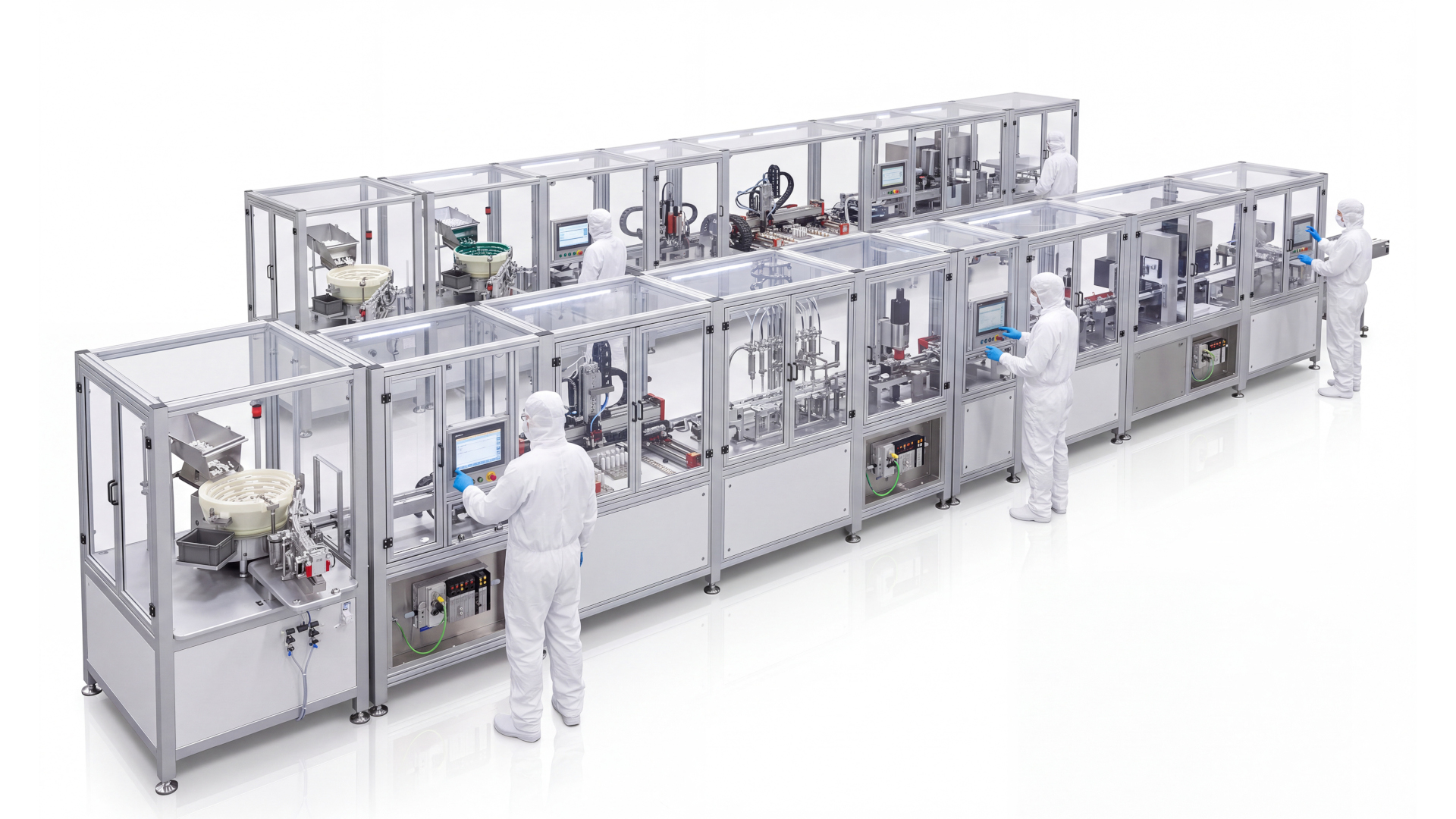
A typical device assembly process might look something like this:
Feed → Singulate → Move → Grip → Orient → Insert → Inspect → Transfer
This process-led approach is something we have been building into our own medical device automation selection work. For example, loose injector bodies, caps, springs or canisters may first need feeding and singulation.
A component can then require high-speed transfer into an assembly nest, gripping, reorientation and finally controlled insertion or pressing. Once we look at the machine in this way, the relationship between different automation technologies becomes much clearer.
Feeding is the beginning of repeatability. A high-performance assembly station cannot compensate indefinitely for inconsistent component presentation upstream. Small medical device components may need to arrive at the next station correctly separated and orientated, repeatedly and at production speed. This is where Afag feeding technology becomes important.
Our application work identifies component feeding and orientation as the starting point for parts such as injector bodies, caps, springs and canisters. But feeding should not be considered in isolation. Once the component has been presented correctly, it still needs to be transferred, positioned, gripped, potentially rotated and assembled. That leads to the next part of the architecture.
Precision handling connects the process. Medical assembly machines contain a remarkable amount of movement. Components move from feeders into nests. Parts transfer between processes. Grippers hold delicate components. Rotary modules change orientation. Linear axes position parts for assembly or inspection. This is where Afag’s feeding and handling technologies can work together.
The portfolio includes feeding solutions together with linear and rotary handling modules, grippers and pick-and-place systems for moving small components, subassemblies and fixtures. This becomes particularly interesting when we stop thinking about these as independent products.
For an MDI (metered-dose inhaler) assembly concept, for example, we have mapped a process from feeding and orienting canisters, actuator bodies, valves and caps through transfer and positioning, assembly and insertion, inspection and ultimately outfeed.
The architecture brings Afag precision feeding and handling together with AVENTICS pneumatic and electric motion. The same thinking can be applied well beyond inhalers. Our internal application work covers manufacturing processes around injectables, CGMs (Continuous glucose monitors) and wearables, inhalers, catheters and diagnostic devices.
Pneumatics still has an important role. There is sometimes a tendency to frame machine design as a choice between pneumatic and electric automation. I don’t believe that reflects how the best machines are actually designed.
There are applications where electric motion provides the flexibility, positioning or motion profile the process requires. There are other applications where pneumatic actuation remains an extremely effective solution. And increasingly, the two coexist. AVENTICS cylinders, valves and air-preparation technologies can provide controlled motion, pressure and compressed-air management alongside Afag feeding and handling systems. In an injectable-device assembly process we have studied, for example, there are opportunities across main-body feeding, transfer to a nest, sleeve insertion, spring feeding and insertion, plunger-rod feeding and plunger insertion. The mapped automation architecture uses a mixture of Afag feeding and handling products together with AVENTICS motion, valves and air preparation.
That is a much better representation of modern automation than asking whether a machine should be “pneumatic or electric”. The question should be: What is the best technology for this particular movement and process requirement?
The bigger opportunity is the machine architecture. This is where I think the conversation becomes much more interesting.
A machine builder may be able to optimise an individual station very successfully. But medical-device manufacturers increasingly need production concepts that can be repeated and scaled. The automation decision therefore affects more than movement. It can affect machine development, integration, process repeatability, commissioning, maintenance and ultimately how easily a proven equipment concept can be applied again.
In our customer-facing work, we have condensed this into three areas:
- Regulatory confidence. Stable and repeatable machine behaviour provides a stronger foundation for validation and process documentation.
- Scalable throughput. Feeding, handling, motion and pneumatics need to work together so that increasing production speed does not simply move a bottleneck somewhere else on the machine.
- Engineering efficiency. Modular, configurable automation building blocks give machine builders a greater opportunity to reuse proven engineering rather than starting again for every new device programme.
That last point is especially important. The objective should not simply be to build one good machine. It should be to build a good automation architecture that can become the starting point for the next machine.
Engage around the application, not the shopping list This also changes how automation suppliers should work with machine builders. If we enter the discussion after every major design decision has already been made, the conversation naturally becomes: “Which cylinder fits here?” or “Can you quote this gripper?” Those are necessary questions, but they come very late in the process.
A more valuable conversation starts earlier: What component are you handling? How is it presented? Where does it need to go? Does its orientation need to change? Does the process require controlled force or position? What cycle time is required? What environmental requirements apply? And, importantly, is this station likely to become part of a machine architecture that will be used again?
Our own selection methodology now starts with exactly these kinds of parameters: part characteristics, required motion, the process itself, environmental requirements and the control architecture. That is where an automation partner can add considerably more value than simply responding to a bill of materials. Where I think medical device automation is heading for me, the exciting opportunity is not a single new actuator, gripper or feeding technology. It is bringing these technologies together more intelligently.
Afag brings precision feeding, linear and rotary handling, gripping and pick-and-place technologies. AVENTICS brings a broad pneumatic automation and electric motion portfolio.
Together, they give us the opportunity to look at much more of the medical-device assembly process as an interconnected automation challenge rather than a series of unrelated component decisions. And that’s increasingly how I believe we need to approach medical device assembly. Start with the process. Understand how the component needs to move from loose part to assembled product. Then select the feeding, handling, gripping, motion and pneumatic technologies around that process.
Because ultimately, the best automation technology isn’t necessarily the component with the longest specification sheet. It’s the technology that makes the machine simpler to engineer, repeatable in operation and easier to scale into the next production challenge.
Visit the Automation in Medical Manufacturing section on Emerson’s Discrete Automation site for solutions for rapid delivery and safe, reliable, and compliant performance of medical products and equipment.
