
Imagine that you are responsible for managing incoming pipeline product flows for a hydrocarbon storage and distribution terminal. Today, Refinery A has been sending gasoline for 16 hours but will switch to diesel later. You know you will have to reroute the incoming flow from the gasoline storage tank to the diesel tank as quickly as possible, while allowing for some mixed product that must be diverted to the slop tank to minimize cross contamination. The key question is, when will you know that the product change has reached you so you can change the flow from one tank to another?
You can try to calculate the changeover point based on flow or time, provided you have a thorough understanding of the pipeline, but this does not give an actual indication of what is passing through at a given point. Is there a simple method for recognizing the product change in real time without the need for analyzers or grab samples? This is the topic of our article in Hydrocarbon Engineering, Perfecting Pipeline Processes, where we explore the most practical and least expensive mechanism for differentiating between common hydrocarbon products in a pipeline while they’re flowing.
The question becomes, how do operators know when the product interface arrives so they can change the valves, just-in-time, to minimize slop and avoid lager contamination? Possibilities include:
-
- Grab samples for manual evaluation by eye or in a lab
- An analyzer using a sampling system checking at regular intervals
- A density meter running continuously, using a bypass stream
- A density sensor, such as a vibrating fork, inserted into the pipeline.
The common element of all these is that they require contact with the process media, and some even call for withdrawing actual samples. We can avoid those other related issues if we keep in mind that common hydrocarbon products have fairly clearly defined differences in three areas:
- API gravity
- Density
- Sound transmission speed.
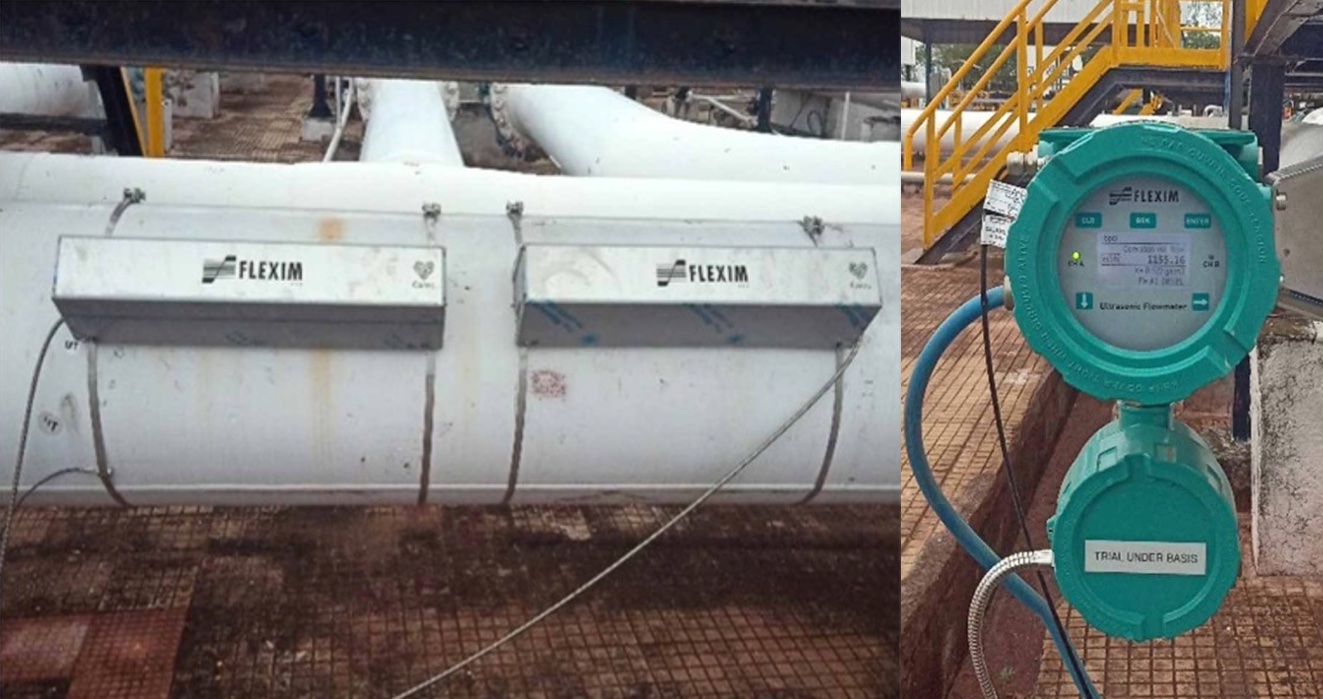
Fortunately, there is a way to measure all three of these parameters in real time using one instrument and without a process penetration using Emerson’s Flexim FLUXUS H831 Hydrocarbon Meter for Standard Volume Flow in Hazardous Areas.
This sophisticated, non-intrusive flow meter combines very precise ultrasonic flow and sound speed measurement, plus advanced calculation features and diagnostics. To provide a high level of reliability in hydrocarbon applications, it has a robust, durable, and hazardous-rated housing. The FLUXUS H831’s built-in HPI computer calculates API gravity, operational density, density at base conditions, and kinematic viscosity. Volumetric flow rates reported by the meter are automatically compensated for live temperature and pressure inputs according to industry standards ASTM1250, GPA TP25, D4311, and ISO 91. These capabilities make it ideal for determining when a product interface is moving through the pipe in real time.
The article includes a specific case study, including how one facility tested the meter to verify its accuracy before deploying it in their operations. Once the engineers were convinced, it was installed on an 18-inch pipeline, where it operated in parallel with an existing turbine flow meter and density meter. Having all the required data from a single device made the FLUXUS H831 more convenient, but it also outperformed the existing setup.
Following the installation of the new meter at a measuring point 42 feet downstream from a 90-degree bend, the system detected the interface transition between motor spirit [gasoline] and diesel. Key findings include:
- Density measurement accuracy: 0.19 lb/ft3
- Gross flow rate accuracy: ±1% of reading
- Interface detection alignment: the density values recorded by the Flexim meter matched the refinery’s turbine flow meter and density meter within a 20 sec. time frame.
As this company and others have discovered:
There are many methods used by terminals and similar installations to detect and measure product interfaces. While many approaches are capable, not all can deliver the precision of ultrasonic flow meter technology. Few technologies can provide the entire range of variables of interest from a single transmitter, working in conjunction with a temperature sensor, and are capable of evaluating hydrocarbon products, all without a process penetration.
For more information, visit Emerson’s Flow Measurement Systems pages at Emerson.com. You can also connect and interact with other engineers at the Emerson Exchange 365 community.