
Demand for electrification metals such as copper, nickel, and cobalt is outpacing supply, and mining operators are turning to advanced automation to increase production sustainably. Reliable level measurement sits at the center of that effort, supporting safer operations, better process control, higher equipment availability, and stronger ESG performance.
Why It Matters
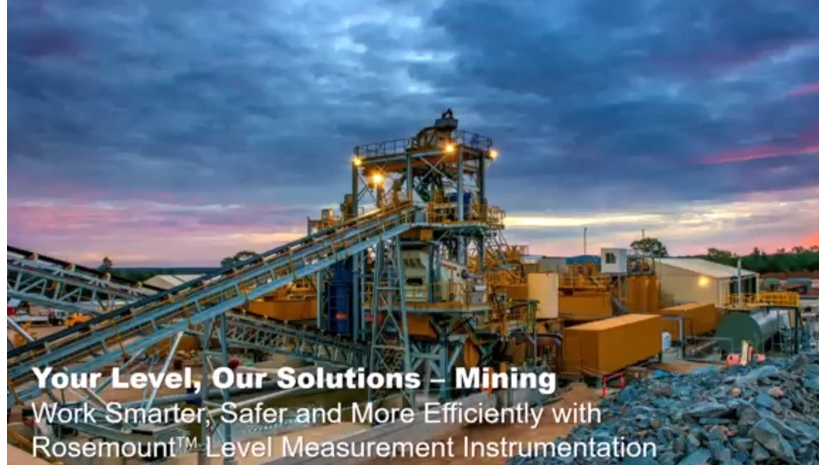 Brownfield mines have depleted their easy ore beds, greenfield projects take years to come online, and stricter license-to-operate requirements demand measurable progress on water use, emissions, and waste handling.
Accurate level and inventory data feed the dashboards, control loops, and reporting systems that enable sustainable production. For process control and instrumentation engineers, choosing the right level of technology for each application is the difference between continuous production and unplanned downtime. The walkdown, summarized below and presented in the webinar Your Level, Our Solutions – Mining Edition by Shivam Mishra, Ingemar Serneby, and Jorge Espinoza, maps where level measurement matters most across a modern mine.
Key Takeaways
- Non-contacting FMCW (Frequency Modulated Continuous Wave) radar (Rosemount 5408 and 3408) handles dust, vibration, and long ranges in ore passes, crushers, silos, and stockpiles. Non-contacting FMCW (Frequency Modulated Continuous Wave) radar (Rosemount 5408 and 3408) handles dust, vibration, and long ranges in ore passes, crushers, silos, and stockpiles.
- Guided wave radar (Rosemount 5300) delivers accurate interface and steam drum measurements, with signal-quality diagnostics that flag probe buildup before data loss.
- Point-level switches such as the Rosemount 2160 wireless vibrating fork and Rosemount 2501 rotating paddle provide robust high and low-level alarms and overfill protection.
- Wireless instruments that use self-healing mesh networks reduce installation costs, keep personnel out of hazardous areas, and enable quick access to remote sites.
- Inventory solutions, including Rosemount TankMaster software and Rosemount 2405 Monitoring Hub, consolidate data from small tank clusters to master control rooms and mobile devices.
- The right technology depends on material type, measurement range, process conditions, and installation constraints. No single sensor fits every application.
Choosing the Right Level of Technology
Shivam opened with a refresher on the three core measurement technologies used to measure level in mining. Non-contact FMCW radar transmits a continuous signal whose frequency varies over time; reflections from the material surface are used to calculate the level. Because it does not touch the process, it suits harsh conditions, high temperatures and pressures, corrosive media, and both liquids and bulk solids.
Guided wave radar sends a microwave pulse down a probe or cable and measures the reflection from materials with different dielectric constants. It is accurate and well-suited to narrow tanks, interface measurement, and foam applications, but it requires process contact. Point-level switches, including rotating paddles, capacitance, vibrating rods, and vibrating forks, signal when a predefined level is reached and are commonly used for overflow prevention, empty detection, and high- or low-level alarms.
The webinar then walks through different parts of the mine and explains how level measurement adds value across the entire mining and ore processing value chain.
Excavation Through Crushing and Stockpiling
Mining operations span wide open areas, so level and height supervision of stockpiles and remote fuel tanks must be visible from a control room or a handheld device. Ore passes, the shafts used to transfer ore and waste between mine levels, must maintain a minimum ore layer above the steel feed frame to absorb the energy of falling rock.
Non-contacting radar handles the uneven walls, long drop distances, and heavy dust that defeat legacy sensors. Rosemount 5408 and 3408 radar gauges, with optional air purging, are well-suited here. Diesel inventory at remote sites is monitored using the Rosemount 2405 remote display and Rosemount TankMaster software, accessible via the company’s internet connection, 4G, or mobile devices. Underground ore storage bins, often 35 to 40 meters tall, combine continuous Rosemount 3408 measurement with the Rosemount 2500 solid point level series; the Rosemount 5408 covers silos taller than 30 meters with up to 150 meters of range.
Ingemar then walks through the Mechanical Processing section of the ore processing. The primary crusher receives ore in its least uniform state, so non-contact radar measures material depth at the feed entry to keep operators inside the optimal flow window, detect plug-chute conditions, and confirm a clean discharge to the conveyor. Maintaining chute level and preventing rock-on-metal contact relies on the Rosemount 5408 and 3408 in a feedback control loop.
Conveyor belts account for up to 50% of unscheduled production disruptions, so buffer silos at transfer points need both continuous and point-level measurement. The Rosemount 3408 signal quality metric detects antenna buildup and enables proactive maintenance. Downstream, the same transmitters provide reliable height measurement for stockpiles and for radial or rotary stackers that automate positioning based on pile height.
Separation, Flotation, and Leaching
Hydrocyclones perform best with steady slurry flow. The Rosemount 1208 level transmitter, paired with the Rosemount 3490 controller and an open-channel flow algorithm, maintains stable feed rates, optimizing separation efficiency. In flotation cells, froth thickness drives recovery and product quality; Rosemount 3408 and 1208 transmitters measure the top of the froth and the liquid level, while the 3490 calculates froth thickness. Thickener tanks use the same 1208 and 3490 combination to monitor gravity-driven solid-liquid separation while keeping flow meters out of the discharge stream.
For heap leaching, implementing the Rosemount 5408 and 3408 radars will ensure proper level control in the PLS and IPS ponds, enhancing operational reliability and accuracy. The Rosemount 3408 Wireless eliminates the need for trenching and cabling, enabling faster commissioning. Jorge described a copper mine in Chile where buildup on a competing guided wave probe killed the signal within days. Emerson’s signal-quality metrics flagged the buildup early, allowing operators to schedule probe cleaning and keep the solvent extraction process visible without unplanned shutdown.
Tailings, Utilities, and Auxiliary Operations
Tailings dams use Rosemount 3408 Wireless or Rosemount 1208 FMCW radar, which are unaffected by wind, sunlight, or temperature fluctuations that can compromise ultrasonic readings. The Rosemount 2160 wireless vibrating fork detects rising slurry beds in mining ponds before they reach pump inlets, with a battery life of up to 10 years at a 1-minute update rate.
Because mines often sit far from natural gas pipelines and stable grids, LNG and LPG storage are common. Emerson’s Rosemount tank gauging solution supports custody-grade inventory for cryogenic and pressurized tanks.
Steam drum level control on water tube boilers, used in the power generation section of utilities, employs the Rosemount 5300 guided-wave radar with dynamic vapor compensation to compensate for changes in steam dielectric and avoid run-dry or carryover damage.
Small tank inventory across reagents, sulfuric acid, and water is centralized through the Rosemount Tank Monitoring System, with local Rosemount 2405 displays, TankMaster software at headquarters, and TankMaster Mobile for field access. Some customers have integrated inventory data with their ERP systems to automate reorder triggers with chemical vendors.
Watch the Full Walkdown
The presenters cover each application in detail, including guidance on product selection and customer examples. Watch the on-demand webinar: Work Smarter, Safer, and More Efficiently Across the Mining Value Chain with Emerson Level Solutions and visit the Measurement Instrumentation for Mining and Metals section on Emerson.com to learn more ways to optimize your mining operations.