
Emerson has published a comprehensive new handbook, ‘How to Prepare Storage Tanks for Automatic Tank Gauging Systems’, to support organizations implementing radar-based tank gauging systems to enhance inventory management and safety. We asked Ola Håll, one of the major contributors to the handbook, to reveal some of its insights and explain why it should be viewed as an invaluable resource for anyone tasked with designing, constructing and equipping storage tanks to accommodate automatic tank gauging systems.

The new Emerson handbook, ‘How to Prepare Storage Tanks for Automatic Tank Gauging Systems’, describes industry best practices in relation to storage tank design and the installation of automatic tank gauging system equipment.
What is the purpose of the handbook?
Accurate and reliable tank gauging is vital for inventory and custody transfer purposes, while protecting financial integrity and avoiding costly discrepancies. It also maintains safety by preventing overfills, leaks and spills. However, even the most advanced automatic tank gauging systems can deliver suboptimal results if storage tanks are not properly designed and equipped to support them. The Emerson handbook serves as a practical engineering guide that describes industry best practices in relation to vessel design and equipment installation. It will help you to maintain industry compliance, enhance reliability and boost operational efficiency with your automatic tank gauging system.
How does the handbook help with compliance?
Reliable tank gauging supports regulatory and environmental compliance by meeting strict reporting and safety standards. The accuracy and reliability of an automatic tank gauging system can be maximized by following the guidelines outlined in various international standards covering the measurement of level and temperature in petroleum and liquid petroleum storage tanks by automatic methods. These standards include the API Manual of Petroleum Measurement Standards (MPMS) chapters 3.1B (automatic level gauging), 3.3 (automatic level in pressurized tanks), 3.6 (hybrid tank gauging), and 7.3 (temperature), as well as the ISO 4266 series (automatic methods), API 2350 (overfill) and IEC 61511 (SIL certification). The handbook not only outlines these standards but translates their requirements into concrete design and installation rules for storage tanks, making compliance easier to achieve.
What types of storage tanks does the handbook cover?
The handbook provides best practice recommendations and illustrations to help you with installing instrumentation and infrastructure for modern radar-based automatic tank gauging systems on floating roof tanks (internal and external), fixed roof tanks and pressurized tanks (sphere and bullet). It also includes comprehensive checklists, enabling you to tick off each separate design and installation requirement for the type of tanks that you have.

The handbook addresses the installation of automatic tank gauging equipment on floating roof tanks (as illustrated here), fixed roof tanks and pressurized tanks.
Does the handbook explain the core measurements required for accurate tank gauging?
Yes, the guide provides extensive information on the various measurements required for accurate tank gauging, the technologies available to deliver these measurements, and advice on how these instruments should be installed. For example, the guide explains that level is the primary parameter to measure, and that in combination with the tank’s strapping table, level measurement enables the observed gross volume to be calculated. It also describes the importance of temperature and density measurements, and why it is often necessary to measure water cut (i.e., the amount of water that has separated and settled at the bottom of the tank beneath the product).
Does the handbook provide guidance on preventing tank overfills?
Absolutely. Overfill prevention solutions are essential for risk reduction, and the handbook explains how API 2350 provides a comprehensive standard and guideline for overfill prevention and mitigation. It describes how the automatic tank gauging system itself forms the first layer of overfill prevention by providing alerts and alarms when predefined tank levels are reached. A second layer of protection, known as the safety layer, is then added, using either a level switch connected to an alarm system or an automatic shutdown function, or a continuous measurement device, such as a radar level gauge. The next layer is known as the passive protection layer. This provides secondary containment such as dikes or concrete walls. Finally, there is the emergency response layer, which as the name suggests, involves alerting the fire brigade and other emergency services. The handbook also explains typical installation requirements for overfill prevention equipment.
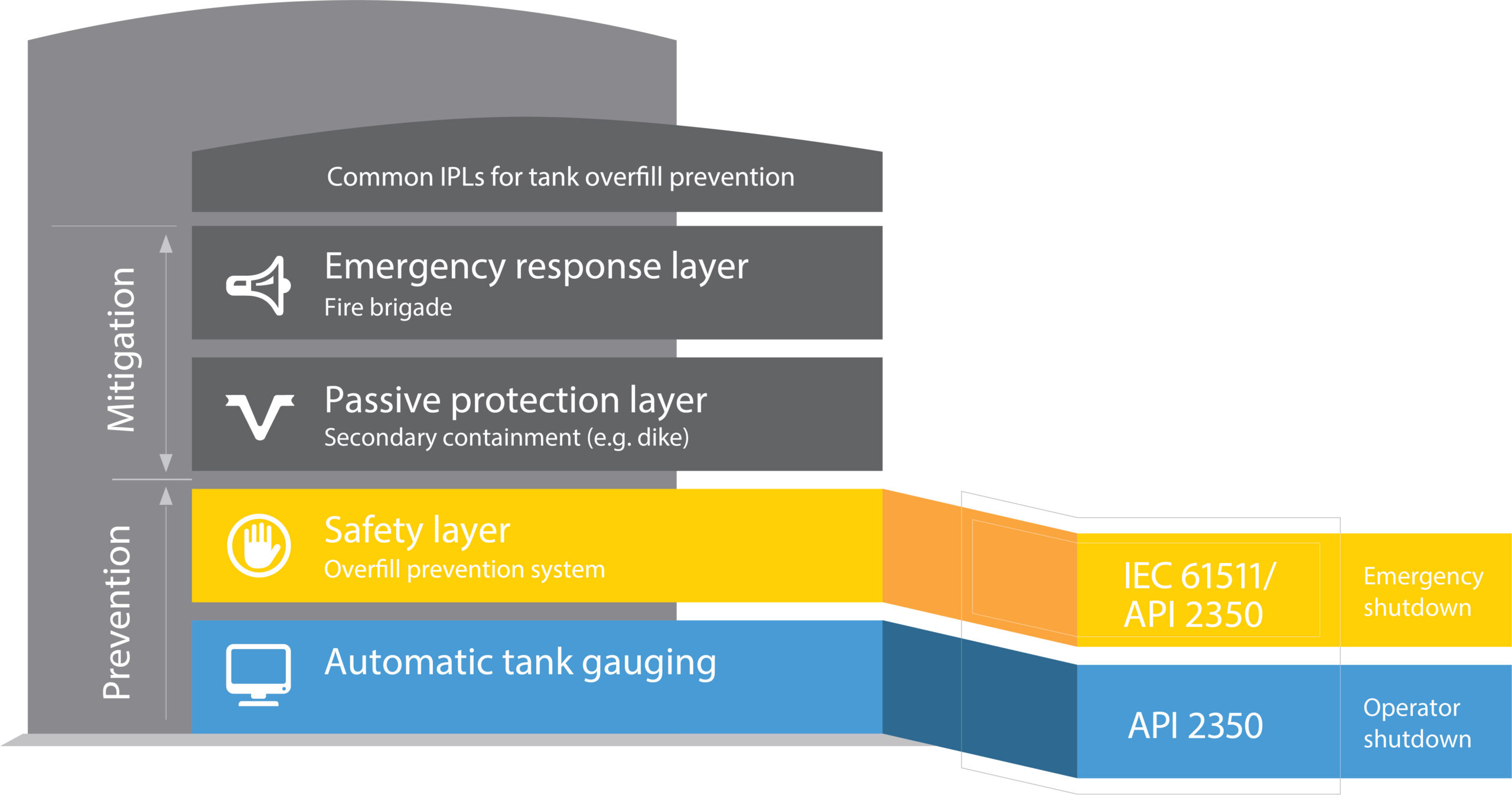
The handbook outlines the different layers of overfill prevention and mitigation.
Is the handbook useful even if I am not installing an automatic tank gauging system yet?
Yes, even if you are not installing an automatic tank gauging system now, the guidance contained in the handbook will help you to prepare your tanks so that they can accommodate such a system in future. Following the handbook’s best practice advice will enable you to future-proof your tanks during new construction (designing nozzles correctly), API 653 overhauls (adding automatic tank gauging capability) and routine maintenance (verifying the condition of still pipes).
Where do I begin?
You can download the handbook here. You can then find all the information you need for the specific type of tanks you have (floating roof, fixed roof or pressurized) and go through the relevant checklist to tick off all the items you need to consider. By diligently following the industry standards, installation guidelines and best practices outlined in the handbook, you can ensure accurate and reliable tank gauging with robust overfill prevention, helping you increase your operational performance and protect the safety of your personnel and assets.