
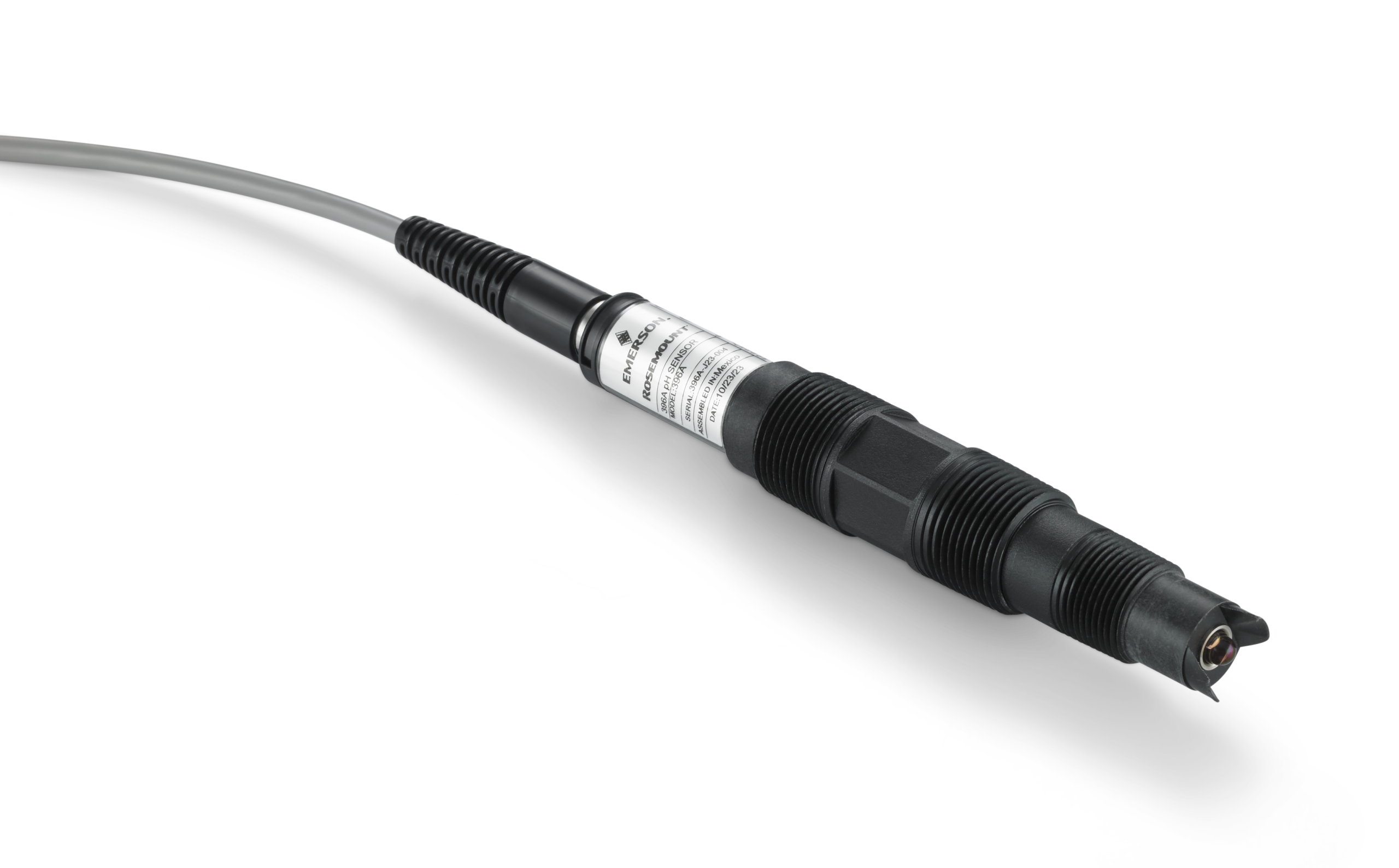
One common type of commercial running on TV today is for new types of non-stick pots and pans. They go to great lengths to prove that whatever you cook, it slides right out and you never have to scrape the bottom. Many industrial applications also have to solve sticking issues, especially for liquid analysis, such as pH probes. The ability to deliver an accurate measurement depends on the sensor reaching the actual liquid, and where the process deposits a coat of solids, it can block that capability off entirely. This often calls for extracting the probe, if that’s even possible during operation, and cleaning off the crud.
Emerson has created a new digital probe designed for all applications, but it’s especially important in situations where coating and fouling from solids disrupt accuracy. Emerson’s new Rosemount™ 396A Anti-Coating pH Sensor is perfect for measuring pH and oxidation-reduction potential (ORP) in dirty, abrasive, and high-solids applications. It includes a robust anti-coating reference design and Modbus digital output, minimizing sensor maintenance and ensuring a steady pH/ORP signal, even when the process media can foul most conventionally designed probes.
The anti-coating feature is a major advance, but 396A is also a digital sensor, rather than analog. It is one of a growing range of digital sensors in the Rosemount catalog designed to reduce the amount of maintenance and calibration required for liquid analysis. Digital advantages include:
- Plug-and-play connector simplifies wiring
- Built-in diagnostics indicate sensor health and aid troubleshooting
- Eliminate common analog problems related to ground loops and EMI
- Bench calibration data is stored in the sensor for easy access when installed
The new 396A can serve as a drop-in replacement for analog Rosemount 396P and 396PVP sensors, making the transition to digital much easier. The Rosemount™ 1058 Dual Channel Transmitter is ideal for these sensors, and it can handle both analog and digital probes, further simplifying the change to digital.
For more information, visit Emerson’s Liquid Analysis pages at Emerson.com. You can also connect to and interact with other engineers at the Emerson Exchange 365 community.