

In upstream Oil & Gas operations, chemical injection is one of those critical processes that rarely gets much attention—until something goes wrong. Corrosion, scale formation, and flow assurance issues can quickly turn into costly production disruptions, safety risks, and unplanned maintenance. As a result, many operators take a conservative approach: inject more chemical than necessary to stay on the safe side.
But that “insurance policy” comes at a price.
Across the industry, operators are increasingly challenged by rising chemical costs, growing infrastructure complexity, and increasing pressure to optimize capital and operating expenditures—all while maintaining reliable asset protection. The question is no longer whether chemical injection is necessary, but how precisely and efficiently can it be controlled.
The Hidden Cost of “Good Enough” Measurement
Traditional chemical injection systems were designed for robustness, not precision. Positive displacement meters and rotameters have been widely used for decades, but they were never intended to operate at today’s ultra‑low flow rates or under rapidly changing wellhead conditions.
In real‑world upstream environments, injection rates are extremely low, fluid properties vary by season, and pressures fluctuate as production conditions change. Under these conditions, mechanical meters can struggle. Under these conditions, mechanical meters often exhibit limitations such as measurement of drift, pulsation sensitivity, and mechanical wear. These factors introduce uncertainty into the flow signal making stable and reliable closed-loop control fundamentally difficult.
When operators don’t trust the measurement, they compensate by over‑injecting chemicals. In one recent project with a leading upstream operator in the Middle East, over‑injection routinely exceeded 20 percent. While this approach reduces immediate risk, it drives excessive chemical costs, introduces downstream process inefficiencies, accelerates material degradation, and increases operational and environmental risk across the production system.
From Reactive Dosing to Control‑Grade Injection
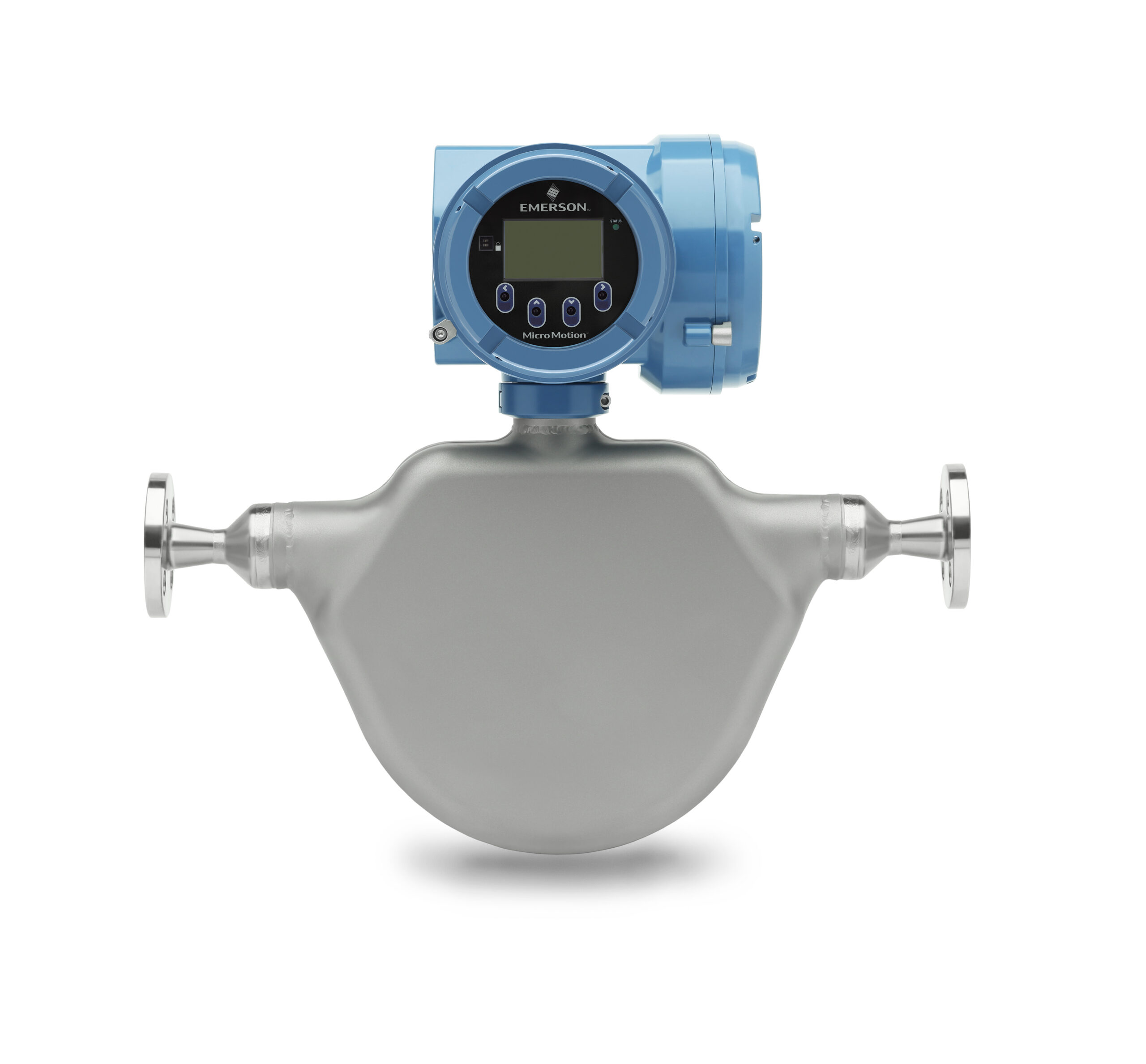
Micro Motion ELITE Coriolis Flow Meter with 5700 Transmitter
What stood out in this project wasn’t just the desire to reduce chemical usage; it was the operator’s recognition that the root cause was control quality, not chemical selection or pump capacity.
To address this, the operator adopted Emerson’s Active Chemical Injection Solution, built around the Micro Motion™ 5700 Coriolis Transmitter paired with an ELITE™ Coriolis Flow Meter and a Fisher™ easy‑e™ control valve. At the heart of the solution is Coriolis technology’s ability to directly measure mass flow independently of pressure, temperature, or viscosity.
This distinction matters. By eliminating the mechanical limitations of traditional meters, Coriolis measurement provides a stable, repeatable signal even as operating conditions change. And because there are no moving parts, that measurement integrity is maintained over time, reducing maintenance demands in harsh upstream environments.
In this architecture, the Coriolis meter continuously measures the actual injection mass flow rate, which is compared in real time against the required dosing setpoint, enabling the 5700 transmitter to locally modulate the Fisher control valve for precise flow regulation.
This closed-loop, control-grade approach ensures immediate response to process variations, eliminates reliance on manual adjustment or indirect estimation, and delivers highly accurate, repeatable chemical dosing at ultra-low flow rates.
The result is tighter process control, minimized over-injection, improved chemical utilization efficiency, and enhanced system reliability—while enabling autonomous operation in remote wellhead environments.
Why Application‑Specific Intelligence Matters
Accuracy alone, however, is only part of the equation. Chemical injection systems face unique challenges—pulsation from pumps, transient pressure events, and rapidly changing flow conditions. Generic filtering can smooth the signal, but often at the expense of responsiveness.
What differentiates this application is the chemical‑injection‑optimized firmware within the 5700 Transmitter. Purpose‑built filtering, damping, and diagnostics are designed specifically for low‑flow chemical dosing. The result is a stable yet responsive control signal, enabling smooth closed-loop control without oscillation—a capability often assumed to be unattainable at such low flow rates.
This represents a fundamental shift. Instead of reacting to measurement uncertainty, operators can now proactively and dynamically control injection rates in real time, maintaining asset protection while minimizing excess chemical usage.
Simplifying the Architecture with Multi‑Stream Injection
Equally important was the opportunity to rethink the physical design of the injection system itself. Traditionally, each injection point required its own dedicated stand by and duty pump, meter, and chemical tank. While effective, this approach significantly increases capital cost, footprint, and operational complexity, particularly as the number of injection points scales.
By transitioning to a multi-stream injection architecture, the operator was able to use a single chemical source to precisely and independently control injection across multiple points. With accurate, control-grade measurement at each stream, independent dosing could be maintained without duplication of infrastructure.
The impact was immediate: fewer pumps, fewer meters, fewer tanks, and fewer ancillary components to install and maintain. This streamlined architecture delivered a substantial reduction in CapEx while simultaneously enhancing system reliability and scalability.
Measurable Results, Sustainable Impact
The combination of stable mass flow measurement, application‑specific transmitter intelligence, and a simplified injection architecture produced tangible results:
- Chemical over-injection reduced by approximately 20–25%, generating significant recurring cost savings.
- Capital expenditure lowered through reduced equipment count and optimized system footprint.
- Stable closed-loop control maintained despite fluctuating pressures and dynamic production conditions.
- Maintenance requirements are minimized due to no-moving-parts design and inline Smart Meter Verification.
- Operational complexity reduced, limiting manual intervention, and improving overall system efficiency.
Just as importantly, the operator gained confidence in the process. Chemical injection shifted from a reactive, overdose‑driven practice to a predictable, control‑grade operation aligned with broader digitalization and optimization goals.
A Broader Shift in Upstream Operations
This project reflects a broader industry transition. As operators pursue efficiency, resilience, and digitalization, legacy approaches based on overdesign and manual intervention are being replaced by intelligent, integrated, and automated control solutions.
Chemical injection may represent a small fraction of total production costs, but it has an outsized impact on asset integrity, flow assurance, and lifecycle reliability. When measurement and control are executed correctly, operators can simultaneously enhance protection, reduce costs, and simplify operations.
The takeaway is clear: precision is no longer optional—it is a fundamental operational requirement. With the right combination of advanced measurement technology, application-specific intelligence, and optimized system design, control-grade chemical injection is not only achievable, but essential for sustainable upstream operations.
Read the full case study here. For more information on Emerson solutions for the Oil & Gas industry, visit our Oil and Gas page at Emerson.com. You can also connect and interact with other Oil & Gas professionals and share insights through the Emerson Exchange 365 community.
