
AI is changing drug discovery faster than most people expected. Commercial manufacturing is next. The organizations best positioned for that shift are the ones preparing now, not because they’re behind, but because the window to prepare thoughtfully is exactly when things still feel calm.
Insilico Medicine advanced a novel drug candidate for idiopathic pulmonary fibrosis from target identification to Phase II clinical trials in roughly 18 months, a journey that traditionally spans a decade. Eli Lilly has integrated AI into its discovery pipeline in ways that are measurably accelerating the pace at which promising molecules move toward clinical development. These are not isolated examples. They are early indicators of a structural shift in how quickly the industry can move a molecule from concept to patient.
The conversation around that shift has been almost entirely upstream: discovery, target identification, clinical optimization. What happens when those accelerated molecules reach manufacturing is a different conversation, and one that is only beginning.
The Pipeline Is Accelerating, and That Changes the Context for Manufacturing
Every molecule that moves faster through discovery eventually arrives at a manufacturing site. As AI-accelerated candidates progress through clinical stages more quickly, the handoff to commercial manufacturing arrives sooner, with less runway, and often with greater molecular complexity. GMP requirements, validation protocols, and patient safety standards remain exactly where they are. What changes is the time available to meet them with confidence.
This is not a crisis. It is an inflection point, and there is a meaningful difference. Manufacturing leaders have built careers on executing reliably under pressure. That expertise is exactly what this moment calls for. What shifts is where the preparation needs to start and how far upstream the conversation needs to reach.
The organizations that will be most ready are not necessarily the fastest movers. They are the ones that recognize early that pipeline acceleration is a signal worth acting on, and that the place to start is earlier in the process than most people instinctively look.
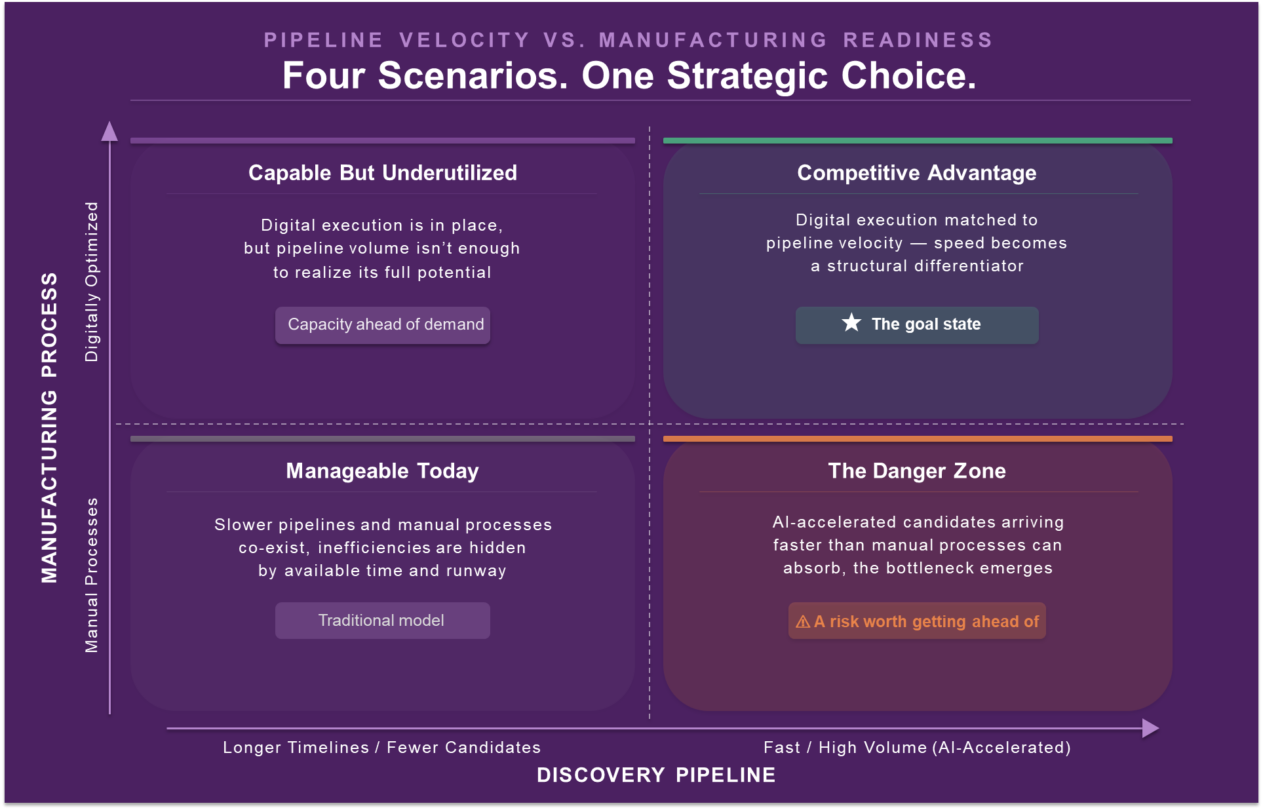
Pipeline Velocity vs. Manufacturing Readiness: Four Scenarios, One Strategic Choice.
Tech Transfer Is Where Pipeline Velocity Meets Manufacturing Readiness
Before a single batch is made, the process needs to be moved. Tech transfer is the handoff of process knowledge from development to manufacturing, and it is the first moment where pipeline velocity either translates into manufacturing readiness or encounters resistance. Under compressed timelines, it becomes one of the highest-impact points in the entire product lifecycle.
The challenge is not that people are doing tech transfer wrong. The traditional approach was built for longer timelines, more transfer cycles, and the kind of deep institutional knowledge that accumulates over years. It was not designed for the pace that is coming. When processing knowledge lives in a subject matter expert’s experience, or in documentation that was never structured for execution, the transfer becomes fragile. Not because of negligence, but because the system was built for different conditions.
The One-Click Tech Transfer initiative, sponsored by Emerson and supported by a consortium of leading pharmaceutical companies, is a direct response to this challenge. The fact that competitors are collaborating on it reflects how broadly the problem is felt. The goal is to standardize and accelerate the transfer of process knowledge, removing the friction and manual effort that slows things down at exactly the moment speed matters most.
Central to that effort is Transfer Hub, an application being built by Emerson to serve as the translator between process intent and execution context. Process engineers and scientists work in the language of functional requirements, design rationale, and process parameters. Manufacturing execution systems (MES, DCS) operate in structured instructions, control logic, and validated procedures. Transfer Hub bridges that gap, ensuring that what was designed is what gets executed, with the fidelity and traceability a regulated environment requires.
Execution Is Where Knowledge Becomes Evidence
Once process intent arrives at the site, accurately translated and fully contextualized, the execution layer takes over. A Manufacturing Execution System like DeltaV™ Manufacturing Execution System (MES) receiving those structured instructions, manages batch execution in a regulated environment, and captures everything that happens in real time. Every parameter, every deviation, every operator decision, every equipment state transition.
The output of that execution is the batch record. And this is where the industry has consistently undersold what it actually has.
The batch record has long been framed as a compliance artifact, proof that the process was followed. That framing is accurate, but incomplete. The batch record is also the richest operational dataset in the building: material genealogy, process performance data across hundreds or thousands of batches, deviation history with context, operator behavior patterns, environmental conditions correlated with outcomes. Most manufacturing organizations are sitting on years of this data, largely untapped as a source of intelligence.
The chain matters here. Process intent flows through Transfer Hub, arrives at DeltaV MES as executable instruction, and is captured in the batch record as evidence. A gap anywhere in that chain limits what is possible downstream, including what AI can do with the data when the time comes.
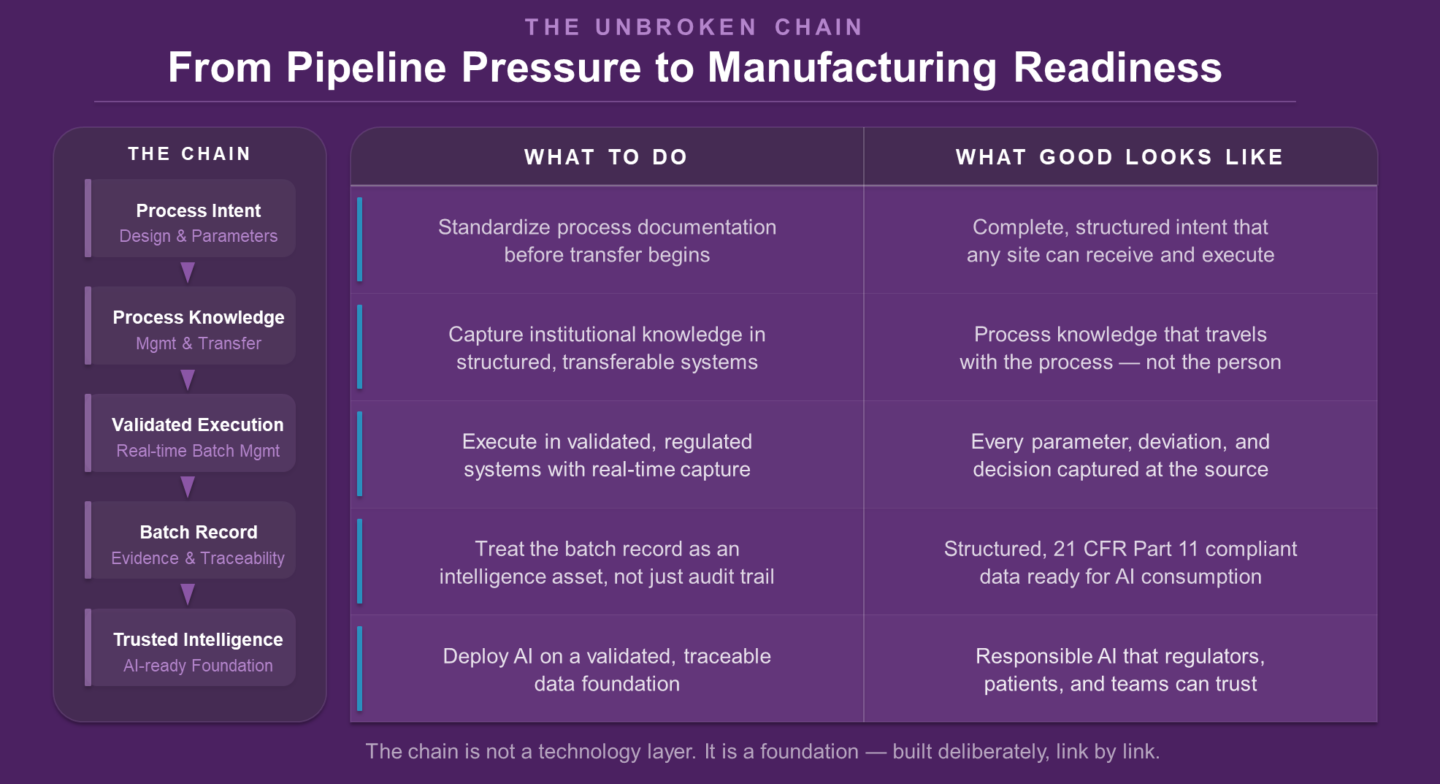
The Unbroken Chain — From Pipeline Pressure to Manufacturing Readiness.
Responsible AI Is a Competitive Advantage, Not a Constraint
AI expert and thought leader Noelle Russell has made a point that resonates in a manufacturing context: the most consequential AI risk is not moving too slowly. It is deploying AI on a foundation that was never designed to support trustworthy, accountable intelligence. The quality of any AI system is only as good as the integrity of the data underneath it.
Most industries are trying to build that foundation retroactively, constructing data governance frameworks and audit trails for AI systems that were deployed before anyone asked the right questions about data integrity.
Life sciences manufacturing is in a different position. 21 CFR Part 11 compliance, electronic batch records, audit trail requirements, GMP validation protocols: these are not innovations. They are the operating baseline. The trust framework that responsible AI requires already exists in a well-run execution environment. It was built for regulators and patients. It also happens to be exactly what you need to build AI you can stand behind.
Traceable decisions. Accountable outputs. Auditable models. This is the language of responsible AI, and it is also the language that quality and compliance teams already speak. The organizations that recognize this convergence will not treat responsible AI as friction layered onto existing obligations. They will treat it as a structural advantage that other industries are still trying to build.
DeltaV Process Knowledge Management (PKM) reinforces this at the process knowledge level, ensuring that what is known about a process is captured, maintained, and transferable rather than held in institutional memory that retires when people do.
The Chain Has to Be Unbroken
The pipeline will not slow down. The regulatory bar will not be lowered. And the AI capabilities being developed to transform manufacturing operations will only deliver on their promise if the data underneath them is trustworthy, structured, and built on a foundation designed with integrity from the start.
That foundation is built before the AI conversation begins. It starts with tech transfer, ensuring process knowledge moves completely and accurately from development to manufacturing. It continues through execution, capturing that knowledge in a structured, validated, traceable way through every batch. And it culminates in the batch record, which is not the end of the process but the beginning of the intelligence layer.
Three questions worth asking about your chain today:
- Can process knowledge move from development to manufacturing without depending on a single subject matter expert’s memory?
- Is your execution data structured and traceable enough that an AI system could use it with confidence, not just a compliance team?
- If a molecule arrived at your site 18 months earlier than expected, what would break first?
Most organizations can’t answer all three with full confidence yet. That is not a failure. It is a starting point, and an honest one.
The manufacturers who will be best positioned in an AI-accelerated era are not necessarily the ones moving fastest today. They are the ones who look up early, recognize that the pipeline signal upstream has real implications for manufacturing readiness, and start building the unbroken chain while they still have the time to do it thoughtfully.
If you are running a validated execution environment today, you are closer than you think. The question is whether the chain is unbroken.
