
In Part 1, we explored why digital strategies that sit above operations break down in regulated life sciences manufacturing. When analytics are disconnected from validated execution, insight loses the context required to support quality, compliance, and release decisions.
The next step is not abandoning enterprise data platforms—but evolving how, and where, intelligence is applied.
From data fabric to execution intelligence
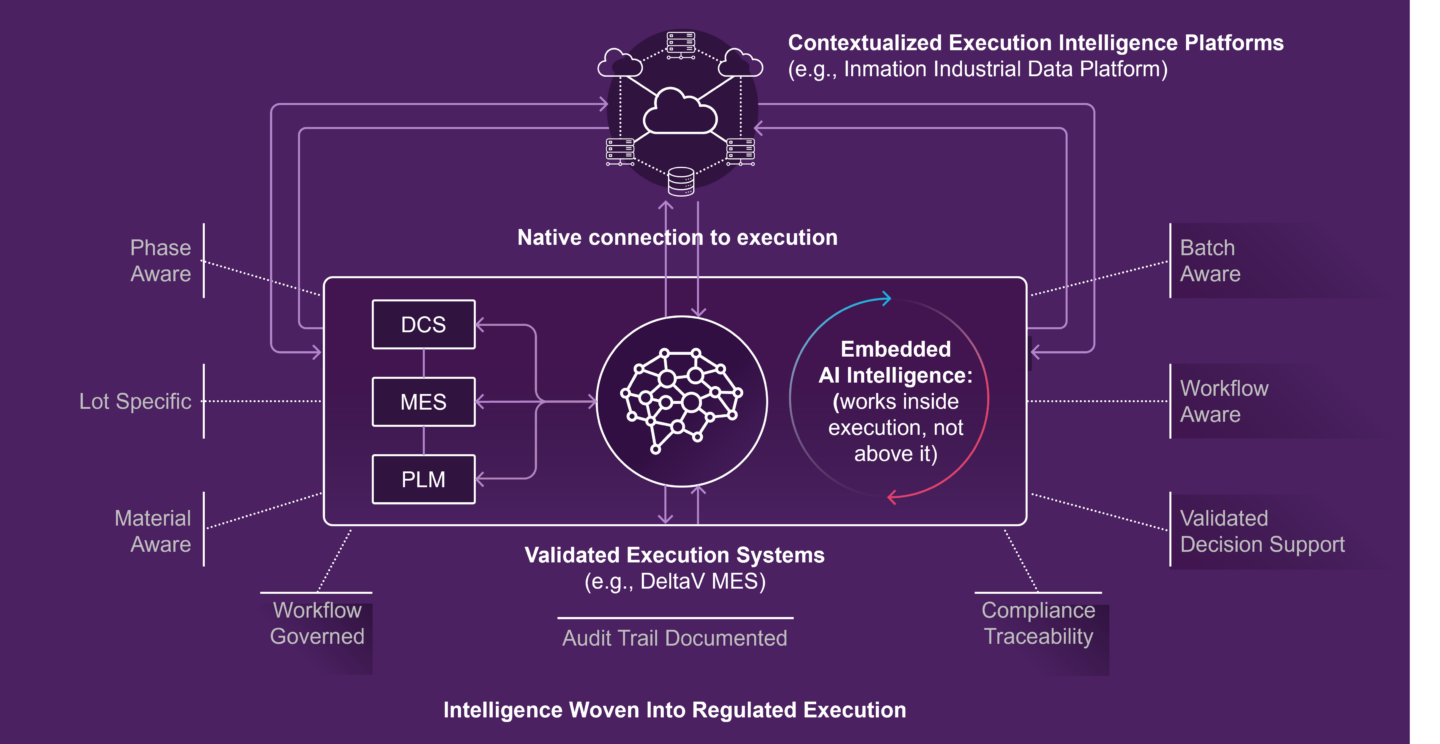
Execution intelligence embeds AI directly into validated execution—connecting enterprise insight to governed workflows, batch context, and quality authority.
Execution intelligence starts from a different architectural foundation. Instead of separating analytics from execution, it embeds intelligence directly within validated workflows and process context.
When insight is anchored to execution systems such as DeltaV Manufacturing Execution System and supported by enterprise-scale contextualization platforms like Emerson’s AspenTech Inmation, intelligence becomes:
- Phase aware
- Lot specific
- Material aware
- Workflow governed
- Audit trail documented
Execution-aware manufacturing platforms such as DeltaV Manufacturing Execution System digitally orchestrate workflows, so data, decisions, and approvals remain connected to their regulated context.
Rather than simply flagging a yield trend, an execution-intelligent architecture can detect drift within a specific unit procedure, associate it with supplier lot genealogy, trigger a controlled review workflow, capture QA decisions, and preserve full compliance traceability.
This is not analytics layered above operations.
It is intelligence woven into regulated execution.
The enterprise dimension still matters
Enterprise data platforms remain essential. Manufacturers still need cross-site visibility and scalable data federation from their existing, fragmented data infrastructure.
Technologies such as Inmation enable enterprise-level contextualization across plants, historians, control systems, and business applications. The opportunity is to ground data fabrics with systems of record for validated execution.
When enterprise data platforms are tightly integrated with execution systems like the DeltaV™ Automation Platform for Life Sciences, organizations gain AI that understands batch state, analytics aligned with governance boundaries, insights consistent with QA authority, resulting in validated decision support within compliant workflows.
This architecture allows enterprise intelligence and validated execution to operate as one.
What this means in practice for life sciences manufacturers
For regulated manufacturers, execution intelligence changes how digital initiatives are evaluated:
- AI initiatives must align with validated systems of record
- Analytics must understand process phase and workflow state
- Insights must support governed action—not just observation
As therapies grow more complex and production models become more flexible, digital infrastructure must evolve accordingly. Platforms such as the DeltaV™ Automation Platform for Life Sciences, combined with enterprise data solutions like AspenTech Inmation helps connect development, tech transfer, and commercial manufacturing into a coherent execution architecture.
This approach supports faster tech transfer and a more consistent understanding of processes across the lifecycle, reinforcing the industry’s focus on accelerating the journey from R&D to manufacturing.
An industry at an inflection point
Life sciences manufacturing is facing accelerating change:
- Smaller batch sizes
- Faster tech transfer
- Real‑time release strategies
- Increased AI adoption
- Greater regulatory scrutiny
Meeting these demands requires more than data unification. It requires purpose-built architecture where enterprise intelligence and validated execution operate as one.
We can build platforms that observe how medicine is made. Or we can build execution intelligence that understands it.
If the goal is to accelerate the journey from lab to life, intelligence must live where medicine is made – inside the validated execution that ensures every therapy is safe, effective, and trusted.
In regulated life sciences manufacturing, AI creates value only when intelligence is embedded in validated execution – not layered on top of it.
