
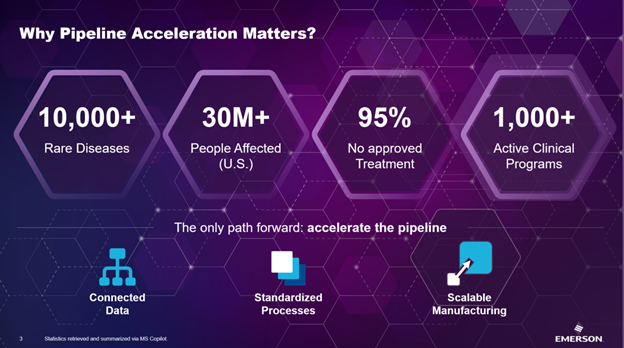
More than 10,000 rare diseases affect over 30 million people in the United States alone, and 95 percent of those diseases have no approved treatment. With more than 1,000 active clinical programs working to change that, the pressure on biopharmaceutical manufacturers to accelerate the pipeline without compromising quality or compliance has never been greater.
That tension between speed and rigor is the focus of an on-demand webinar, “Visibility for BioPharma Operations: From Data Insights to Better Outcomes.“ Hosted by Michalle Adkins, Director of Life Sciences Strategy and Communications at Emerson, the session features a candid conversation between Christian Berg of Emerson and Narayan Gokhale of QKS Group, a global research and advisory firm specializing in technology markets and adoption trends across industrial automation.
Here is a glance at what the webinar covers and why it matters for your operations.
The Business Drivers Shaping Life Sciences Manufacturing
The webinar opens with five critical business drivers: pipeline acceleration, operational integrity, real-time release, flexible manufacturing, and sustainable operations. These are not abstract strategy themes. They represent the daily realities facing engineering and operations leaders who must deliver therapies faster while navigating regulatory complexity, site-to-site variability, and aging manual processes.
Where Process Knowledge Breaks Down
A significant portion of the conversation focuses on what Gokhale calls “a continuity problem.” Critical process knowledge is created early in development, but by the time it moves through Manufacturing Science and Technology, tech transfer, plant engineering, and quality, that context becomes fragmented across documents, spreadsheets, and site-specific interpretations. The result is risk in facility fit, recipe harmonization, and validation readiness. The presenters discuss how connected, structured process knowledge management creates a single source of truth for recipes, enables early facility-fit analysis, and integrates directly with execution systems to reduce time to market.
Scheduling That Reflects Reality
Paper-based batch records carry familiar risks: missing signatures, calculation errors, illegible entries, and deviations discovered long after the fact. The discussion examines how digital workflow execution with embedded exception processes can auto-identify issues in real time, improve right-first-time performance, and shorten the path from deviation detection to batch disposition. Gokhale notes that the strongest outcomes include lower cost of quality, faster batch review, and a more scalable operating model.
Making Data Useful When Decisions Matter
The final technical segment tackles a challenge that is easy to state and hard to solve: biopharmaceutical plants generate enormous amounts of data, but much of it lacks operational context at the moment decisions need to be made. The presenters discuss how contextualized data, connected to the batch, the process state, and the decision workflow, enables organizations to move from retrospective analysis toward real-time, closed-loop control. That shift has direct implications for process understanding, exception reduction, and future readiness for model-based monitoring and artificial intelligence-enabled decision support.
A Lifecycle Approach, Not an Isolated Project
The companies that will gain the most advantage are those that treat digitalization as a lifecycle capability, not as a series of isolated projects. If they can create continuity from process development through commercial manufacturing, they are in a much stronger position to accelerate the pipeline, improve operational integrity, and support more responsive release and supply models over time.
Join the Conversation
This is a practical, conversational session that pairs independent analyst insight with applied Emerson expertise. If you are responsible for engineering, operations, or manufacturing strategy in biopharma, you will walk away with a clearer understanding of where visibility gaps are affecting your speed, quality, and confidence, and what you can do about them with solutions available today.