
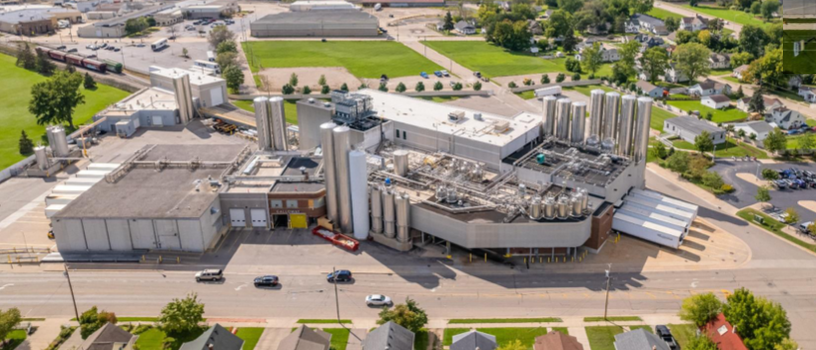
In dairy processing, even small measurement inaccuracies can quickly turn into product giveaway, quality risk, or compliance exposure. That’s why I’m always interested in seeing how customers apply the right instrumentation—not just to measure flow, but to improve decision‑making across the operation. I recently had that opportunity with one of my customers, Galloway Company, who worked with me to document how they’re using Micro Motion™ Coriolis Flow Meters across several critical dairy processing applications.
That story was recently featured in Food Engineering under the headline How Coriolis Meters Helped Milk Processor Galloway Company Reduce Giveaway and Improve Efficiency. I want to thank Perry Van Boxtel, Maintenance Manager at Galloway’s Neenah, Wisconsin facility, for his openness and collaboration. In addition to overseeing maintenance, Perry is also responsible for plant automation. He sees firsthand how measurement decisions impact operations every day. The article goes deeper into the technical details behind each application, right down to specific meter models, and explains how measurement data helped Galloway identify issues that weren’t visible with other technologies.
Galloway processes approximately 55 million gallons of milk annually, with much of that production going to other food manufacturers as ingredients. In an operation of that scale, small measurement inaccuracies can quickly turn into material losses, quality risks, or compliance concerns.
Why Coriolis mattered in this application
What stood out to me while working with Galloway is how consistently Coriolis measurement addressed challenges that other technologies struggled with. Coriolis flow meters measure far more than just flow—they provide mass flow, volumetric flow, density, and temperature in a single device. That combination becomes especially valuable in dairy applications where product properties can change, processes may start and stop, and operators need confidence in every handoff and transfer.
As Perry explained in the Food Engineering article, Coriolis meters also deliver high accuracy across a wide turndown range. That makes them well‑suited for both batch operations and continuous monitoring—and even for determining when a source, such as a bulk dairy truck, has been fully emptied.
Four real‑world applications inside the plant
The article walks through four specific examples where Micro Motion Coriolis meters helped Galloway improve consistency, reduce risk, and gain better process insight:
- Manual pail filling: The facility struggled with inconsistent results on a manual filling line. Installing a Micro Motion H‑Series Hygienic Coriolis Flow and Density Meter significantly improved precision and repeatability.
- Sugar addition for sweetened condensed milk: Measuring sugar accurately had been a challenge, particularly when relying on indirect measurements. With an H‑Series Coriolis meter, the plant can now monitor sugar content directly by measuring density and calculating Brix values online.
- Milk addition in early processing: Magnetic flow meters were previously used to measure milk volumes, but discrepancies were common. Switching to an H‑Series Coriolis meter tightened accuracy and reduced uncertainty.
- Wastewater discharge monitoring: Because the facility can be fined if sugar or milk fat levels are too high, Galloway installed a Micro Motion G‑Series Coriolis Flow and Density Meter on wastewater discharge. Density measurement now provides immediate indication if an upset condition occurs, allowing faster response.
From my perspective, what makes these examples compelling isn’t just the accuracy of the meters—it’s how the additional variables, especially density, helped the team move from reactive troubleshooting to proactive control. Each of these applications highlights a different advantage of Coriolis technology—but together they tell a consistent story: better measurement leads to better decisions.
A practical return on investment
One point Perry made that resonated with me is that none of these improvements required major capital projects. While Coriolis flow meters do carry a higher upfront cost compared to some other technologies, when they’re applied correctly, they often pay for themselves by reducing product giveaway, tightening process control, and freeing operators to focus on higher‑value tasks.
As Perry noted,
“Even though Coriolis flow meters are more expensive than other technologies, when they’re applied well, they earn that money back through cost reductions and increased productivity.”
From my perspective in the field, that’s exactly what successful instrumentation investments should do.
To read the full Food Engineering article and explore how Coriolis measurement was applied across multiple dairy processes, visit the above link. For more information on Emerson solutions for the food and beverage industry, visit our Food and Beverage page at Emerson.com. You can also connect and interact with other food processing professionals and share insights through the Emerson Exchange 365 community.