
Market uncertainty is back and refiners are responding the only way they can – by looking at alternative crudes.
Tariffs, sanctions, shifting trade lanes, and sustained oil price volatility have returned macroeconomic pressure to refining margins in recent months. When feedstock costs are unpredictable, opportunity crudes (cheaper barrels sourced outside a refinery’s typical supply chain) become commercially desirable. While the economics are compelling, the impact on plant health is not always fully anticipated.
Crude switching and blending of unfamiliar feedstocks expose processing units to conditions outside their design envelope. High-TAN crudes, incompatible blend combinations, elevated chloride and salt loading, and variable paraffin content all drive corrosion risk, and usually in ways that outpace conventional monitoring programs. The question is not whether refiners will attempt to diversify their crude slate in the current environment. The question is whether they have the operational visibility to do so safely and profitably and ahead of competition.
The Corrosion Consequences of Switching Crude
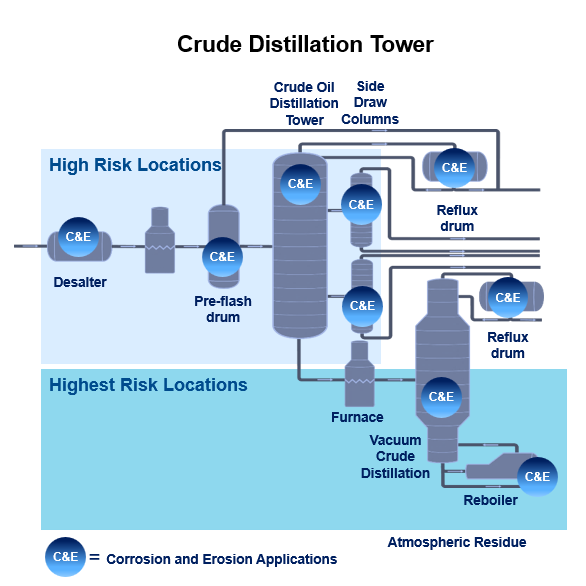
Three mechanisms are particularly relevant when crude slate flexibility increases:
- Naphthenic acid corrosion accelerates in high-TAN crudes above approximately 220°C, targeting transfer piping and column internals. The risk is highly sensitive to blend ratios with a shift from 20% to 30% of a high-TAN component moving the processing unit from within tolerance to serious damage.
- Aqueous corrosion in the crude unit overhead system is compounded by crude properties that compromise desalter efficiency. With the desalter being the entry point to the refinery, any issues at this stage or during primary distillation will cause a ripple effect through the entire facility.
- Accelerated fouling from crude incompatibility creates localized high-temperature zones in the preheat exchanger train, intensifying corrosive attack at precisely the points that are hard to monitor conventionally.
Corrosion coupon programs and periodic manual Ultrasonic Thickness (UT) inspection provide retrospective data, confirming that degradation has occurred, but are not able to provide the early warning needed to adjust operations before damage has occurred. This delay causes issues with managing future strategies – if damage cannot be tied to specific crude runs, then how can it inform future purchasing decision making?
Online Monitoring Goes From Compliance to Operational Intelligence
Continuous, non-intrusive ultrasonic wall thickness monitoring deployed across critical pipe segments provides an online view of metal loss at the sections most vulnerable to opportunity crude corrosion. These locations primarily include the transfer lines from crude and vacuum heaters to the fractionation columns, and other high-temperature, high-TAN exposure points. Unlike intrusive coupons, installation requires no process shutdown. Unlike periodic UT inspection, there are no measurement gaps between inspection windows which can be long in these hard-to-access areas. Data transmitted continuously to the plant historian or asset management system enables rate-of-change trending across the full operating history of the asset, allowing data-informed decision making.
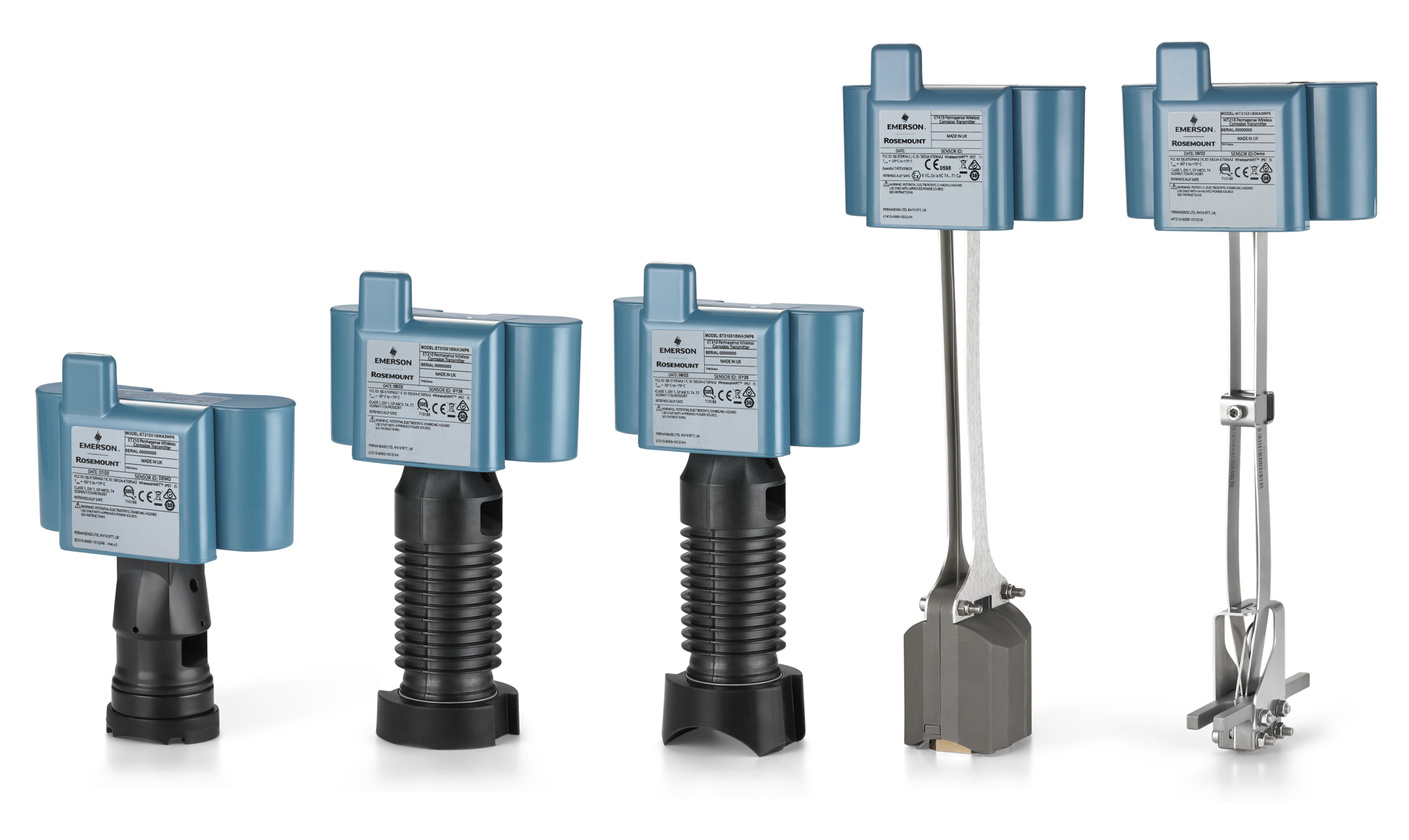
Emerson’s Rosemount™ Wireless Ultrasonic Thickness Corrosion and Erosion Transmitters provide continuous and accurate wall thickness monitoring to determine the impact of corrosion or erosion on your assets.
Faster and More Accurate Detection Using Adaptive Cross Correlation
The most significant advantage of continuous UT monitoring is not measurement frequency; it is measurement stability. Internal pipe roughness, which develops progressively through corrosion and scaling, induces back wall geometry changes that distort the ultrasonic waveform. The result can be apparent thickness variation that obscures genuine corrosion trends and undermines confidence in the data, particularly when attempting to detect the early stages of an accelerating corrosion event.
Emerson’s patented Adaptive Cross Correlation (AXC) signal processing technology directly addresses this challenge. AXC applies historical trend analysis to improve ultrasonic peak detection, compensating for waveform distortion caused by changing back wall geometry. The result is highly stable, repeatable wall thickness measurements, even in the presence of significant internal pipe roughness – the exact conditions that develop in opportunity crude service.
With AXC, corrosion events can be detected within days (not months!) after the fact, delivering faster and more accurate trending against process changes than conventional corrosion monitoring approaches. This response speed enables effective root cause analysis while a process change is still active by correlating measured wall loss rate against crude blend, process temperature, and flow regime in near real time. For operations looking at frequent crude slate changes, this detection capability is a fundamentally different tool for managing asset integrity.
Operational Certainty Across the Full Crude Slate
The refiners best positioned to capitalize on feedstock flexibility, whether it is driven by market volatility or planned optimization, are those who have transformed wall thickness inspection from a compliance activity into a continuous operational intelligence function. Rosemount Wireless Corrosion and Erosion Transmitters provide persistent, non-intrusive measurements backed by wireless data integration that eliminates stranded field diagnostics, and AXC analysis that provides rate-of-change indicators early. These capabilities deliver value regardless of what is being processed and become essential when processing conditions are rapidly changing.
Market conditions will continue to create pressure to diversify crude supply. The refineries that respond with confidence by processing a broader slate, at better margins, with integrity risk fully in view will be those with the visibility to manage the consequences.
For more information, visit Emerson’s Corrosion & Erosion Monitoring pages at Emerson.com. You can also connect and interact with other engineers at the Emerson Exchange 365 community.