

When the owners of a data center say that it must operate 24/7/365, they’re serious, and the thought of being at the mercy of the conventional electric grid to keep going without interruption is often not acceptable. This leaves many sites with their own surprisingly large-scale generating plant to provide inhouse base power with the grid as backup, or vice versa. Either way, there will likely be a gas turbine unit of some configuration similar to a large industrial installation, or even utility scale. This makes the data center subject to the same emissions regulations as any other industry, meaning there must be a continuous emissions monitoring system (CEMS) in place. How data center owners fulfill this requirement is the subject of my article in Data Center Knowledge, Next-Gen CEMS: Simplifying Data Center Emissions Tracking.
Industrial users understand what this means. Countless process plants have combustion equipment supporting all manner of operations. They require constant monitoring of flue gas using CEMS for pollutants such as nitrogen oxides (NOx), carbon monoxide (CO), and others. Monitoring requires gas analyzers to quantify those target gases to ensure they’re below allowable limits. Just because data centers are IT oriented rather than manufacturers does not make them exempt. If an onsite generating plant is running, it must be monitored with an analyzer(s) capable of measuring all the target gases.
So, what’s the best kind of analyzer? Data centers depending on having the latest, most efficient technologies for everything, and this should extend to CEMS. There is much at stake for the choice.
CEMSs for data centers are automated instrumentation packages installed permanently on exhaust stacks to monitor these and other pollutants. Their job is to measure, record, and convey emissions levels in real-time, as well as to maintain the data for later recall and regulatory reporting. However, CEMS are more than mere compliance tools; they are critical to operational uptime. If a CEMS fails or reports inaccurate data, the facility risks heavy fines, forced shutdowns, or generator run restrictions, which are unacceptable outcomes in an industry defined by reliability and uptime.
Traditionally, gas analyzers have a reputation for being expensive and fussy, requiring complex sampling systems and lots of maintenance. Today’s technologies have improved significantly, and Emerson’s Rosemount™ QX1000 Continuous Gas Analyzer is a perfect example of how simple and effective CEMS has become.
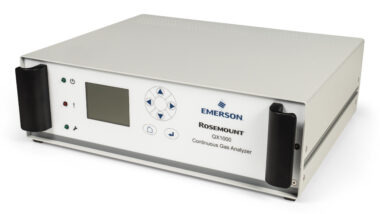
Fortunately, modern technologies are addressing these sources of process inaccuracies, maintenance pain points, and other issues with solutions that handle multifaceted gas matrices. This type of equipment can adapt to different fuel types while meeting low-level measurement requirements, and it is streamlining operations by reducing cumbersome multi-analyzer layouts down to one-component setups.
The article goes into more detail as to how these advantages are implemented in this specific context. Bottom line, this by far the most practical and cost-effective analyzer technology for data center applications. The Rosemount™ QX1000 Continuous Gas Analyzer is ideal for CEMS used with natural gas fired turbines and combined cycle units. Combining laser-based absorption spectroscopy with paramagnetic oxygen measurement, the QX1000 provides highly accurate and continuous gas monitoring tailored for these installations. Its hybrid system delivers highly accurate, continuous multi-component gas analysis, ensuring optimal process monitoring to meet stringent environmental regulations.
The transition from traditional extraction methods to modern spectral analysis provides strategic alignment with the data center industry’s core values: efficiency, space density, and reliability. By adopting technologies and capabilities that reduce mechanical complexity – and engaging with knowledgeable suppliers for full lifecycle support – data center operators can focus their attention on HPC delivery without worrying about emissions and compliance reporting.
For more information, visit Emerson’s CEMS page at Emerson.com.